Museum’s Lancaster team unveils latest restoration milestone in 81-year-old heritage aircraft’s configuration
It took time – 1,750 hours, several hours a week over seven years. Gutless Gert’s tail turret restoration marks just the latest chapter in the 81-year life of the Greenwood Military Museum’s Lancaster.
September 9, 14 Wing Greenwood Colonel Jeff Davis was invited to unveil the aircraft’s new tail: a from-scratch metal, plastic and Plexiglas replica of its Second World War fighting configuration. A team of resourceful museum volunteers put time, skill and creativity into the job.
“As we recognize where we are today and our past, I’m looking forward to the 100th anniversary of the Royal Canadian Air Force next year and what this means for us,” Davis said, as museum volunteers and 14 Wing military members gathered by Gutless Gert. “We rely on the museum as the entry point to Greenwood – the first thing people see. Whenever the wing chief and I visit the museum, we always remark on the contribution of our volunteers, and the pride in their work.
“It’s impressive to see this piece come together: congratulations on this achievement.”
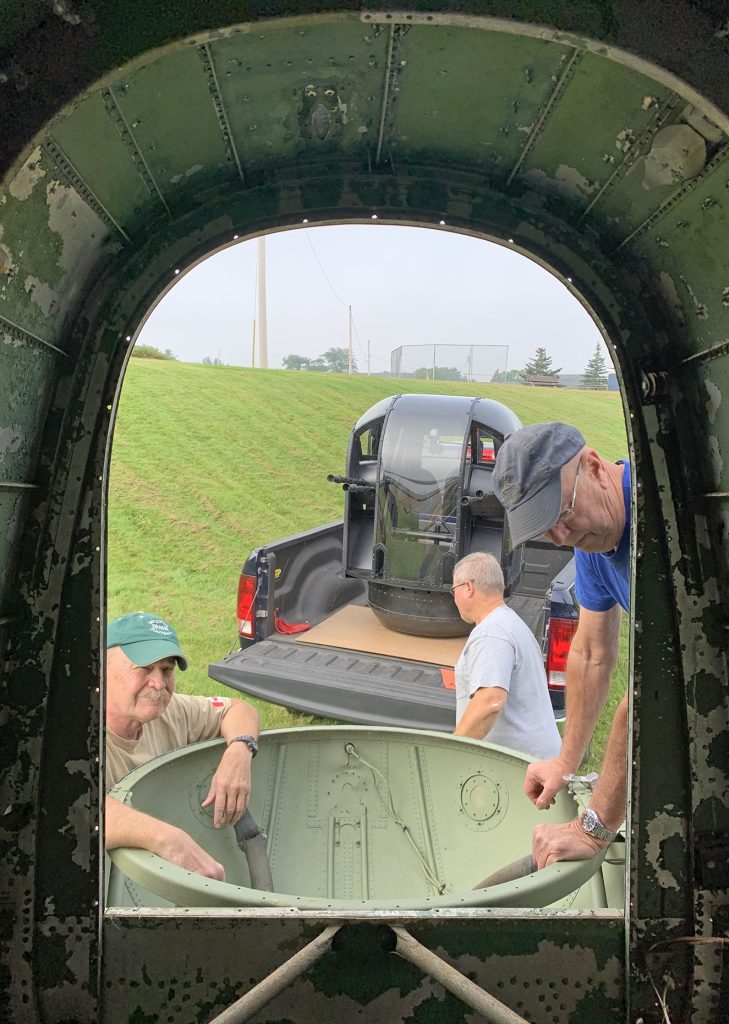
Volunteers Dave Saulnier, Chris Goddard, André Jean and Gary Micklethwaite were behind the restoration work, which began with the October 2016 removal of a mocked-up, inaccurate and aging tail turret.
Goddard (660 hours) and Micklethwaite (70 hours) disassembled, cleaned and repainted reusable parts. Goddard copied and fabricated as many duplicate turret parts as possible to be used in bartering with other museums. André Jean (425 hours) used his technical drawing skills to digitize most of the two dozen parts for two Browning .303 machine guns, plus many other parts; then 3D printed them. Saulnier, the project lead (600 hours), negotiated several intra-museum deals with the Canadian Aviation Museum, gaining intricately machined gun cradles and supports, radios, the bomb sight, and other important missing parts in exchange for a replica turret cupola, built by the GMAM team from molds Saulnier fabricated.
“We had no plans, we bartered with other museums for dimensions for aluminum A-braces and complex gun cradles…, we reverse engineered and fabricated two guns, new moldings, we printed or made it all with 3D plastic and steel,” Saulnier said. “It was all smooth going, all the way – but it just took time.”
Following the unveiling, Saulnier invited guests to climb up a ladder into Gutless Gert’s mid-section, and then take the “incredible journey to the tail turret: navigate the main stabilizer bar, in a small, dark tunnel. It’s claustrophobic, and hot. You can see what it was like.”
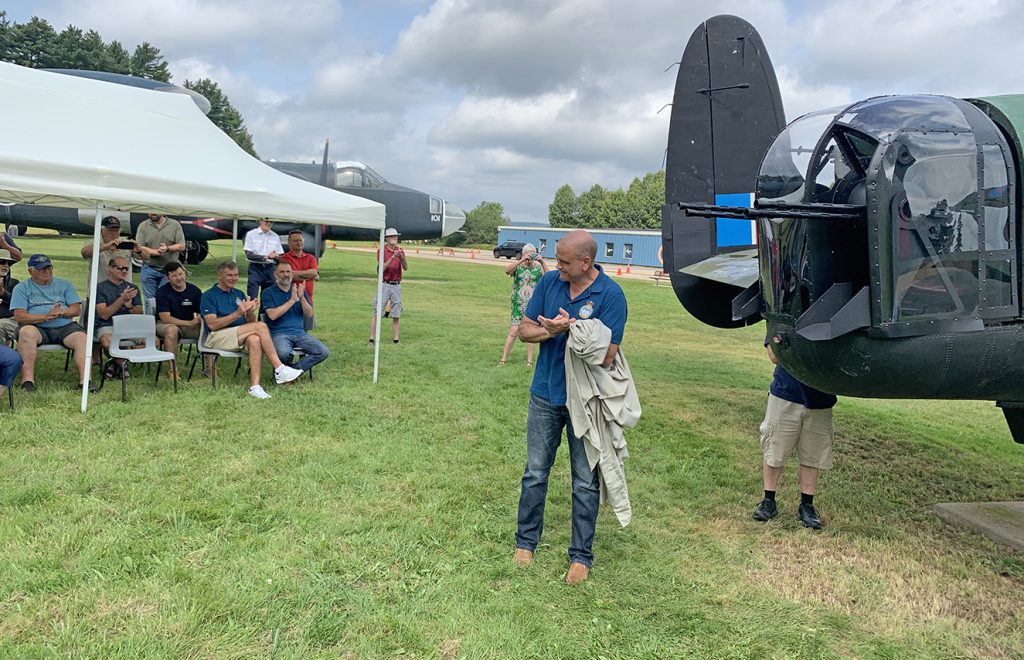

The GMAM’s Avro Lancaster Mk 10 was built in Ontario in 1944, one of 400-plus flown overseas; today, it is one of just 17 left in the world. During the Second World War, Gutless Gert flew 26 missions; the average number of sorties was 14. She would have carried 10,000 rounds of ammunition mid-plane, fed into the tail turret along the floor, and fired at 1,150 rounds per minute per gun. The tail gunner himself was shut into the turret during flight: a poor place to escape from in the event the plane itself was downed.
At the end of the war in Europe, Gutless Gert flew back to Canada to become part of Tiger Force in the Pacific theatre. While in Yarmouth, Japan surrendered. Gutless Gert was then modified and used from 1945 to 1963 on Arctic reconnaissance, carrying camera equipment instead of gun turrets.
Eventually parked in Greenwood, in 2013, the wing commander approved a GMAM project to restore the Lancaster to its wartime configuration, a legacy of 14 Wing’s modern-day 405 (Long Range Patrol) Squadron.