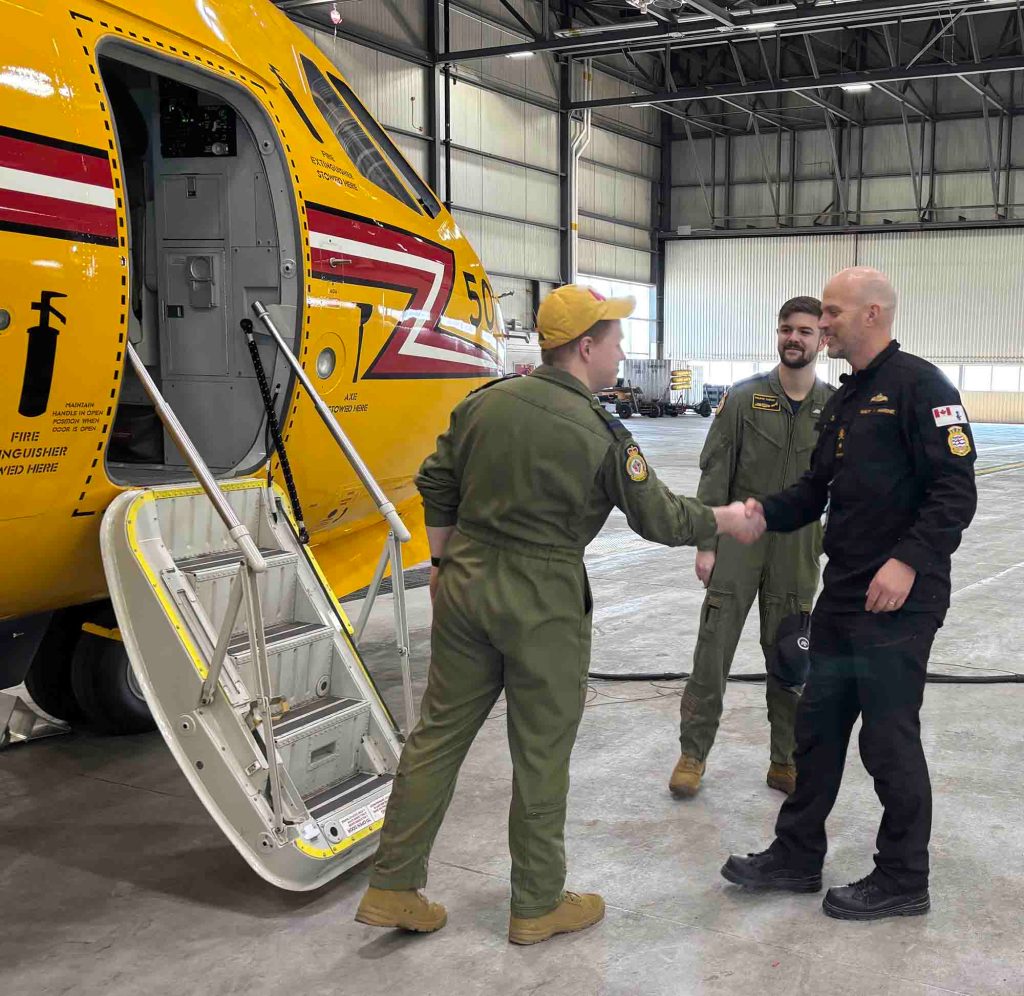
It was all things Navy April 9, as 14 Wing Greenwood hosted two visiting contingents from training and operations partners. Representatives from Canadian Fleet Atlantic, 12 Wing Shearwater and Naval Fleet School (Atlantic) all had the opportunity to tour 14 Wing workspaces, including aircraft, and meet the people often on the other side of the radio.
14 Wing leadership hosted Commodore Jacob French, Chief Petty Officer First Class Patrick Mackey and Lieutenant (Navy) Jonathan Tallis, Canadian Fleet Atlantic; and 12 Wing Shearwater Commander Colonel Tara Willis for a day of briefings on long range patrol, including joint maritime air integration, anti-submarine warfare, force generation and intelligence, surveillance and reconnaissance effects. Guests had the chance to tour the CP140 Aurora, and hear more about the ongoing transition to the P8. With an additional stop at 413 (Transport and Rescue) Squadron, they got an inside look at the shiny new fixed-wing search and rescue CC295 Kingfisher, and discussed interoperability between 413 Squadron and the Halifax Joint Rescue Coordination Centre.
413 Squadron’s operations officer Major Brad Harding briefed the group on the scope of the Halifax SAR region: 4.7 square kilometres of land and ocean territory, including 29,000 kilometres of coastline, with approximately 2,500 annual incidents.
“There is never a time there is no one here, or on call, at the squadron – 24 hours a day, 365 days a year,” Harding said. “We always have a flying crew, with everyone else in training, on standby or working on maintenance.
“We work closely with the Canadian Coast Guard, JROC, and all Royal Canadian Air Force aircraft and Royal Canadian Navy vessels are considered secondary SAR assets. We help each other out, depending on what’s going on.”
Elsewhere on the base throughout the same day, six Naval Fleet School (Atlantic) students and instructors were welcomed to “pinnacle long range patrol squadron,” 405 (Long Range Patrol) Squadron, by Lieutenant-Colonel Joel Stubbert, himself waiting to greet the 12 Wing and Canadian Fleet Atlantic visiting group. The students were in the safety and controls phase of a six-month Fleet School course.
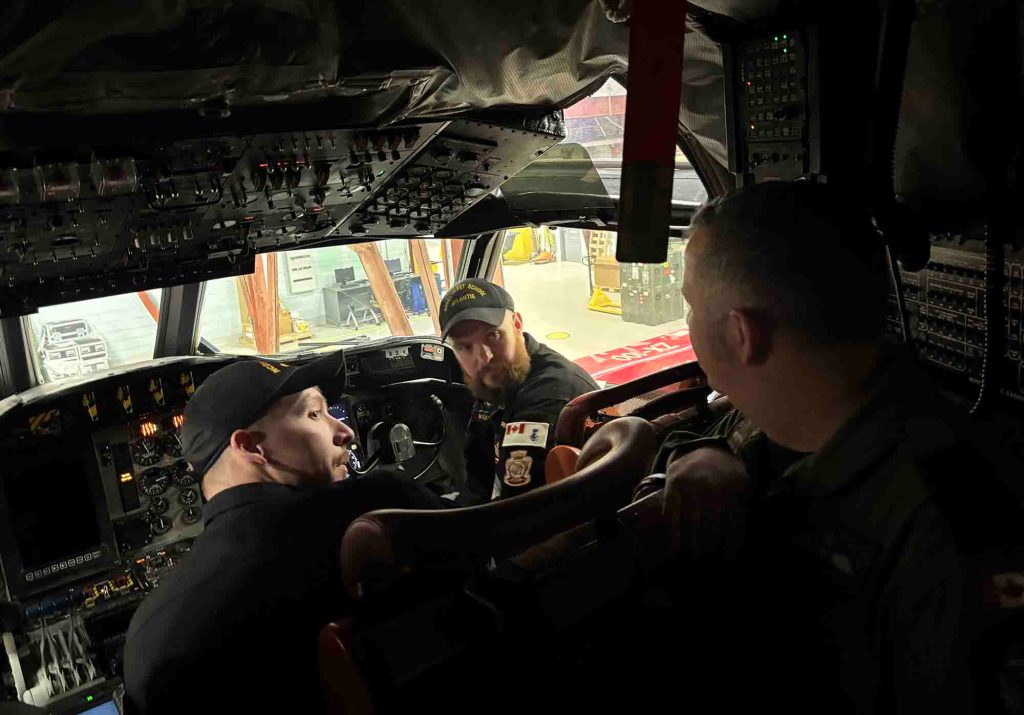
Inside 11 Hangar, Captain Major Chris Inchley welcomed the visitors with a pilot’s perspective on operating the CP140 Aurora.
“The biggest thing you’ll notice over a helicopter is the speed: we have twice the speed,” he said. In the Aurora’s cockpit, the Naval students asked lots of questions about systems and operations, particularly about what the aircrew wants and needs from them, working from ship or submarine, on a training exercise or mission.
“The hardest part is posturing: our speed means we need a couple kilometres out, and that takes planning for you to get us where you want us,” Inchley said. “If we’re at four miles a minute, our turns are huge – but if you want us north-to-south, we can get there pretty quick.”
“So, it’s probably better for us to give you the result we want,” said Fleet School instructor Petty Officer Second Class Michael Huntley.
“That’s a great point,” Inchley said. “We typically turn at a 30-degree tilt. We can go to a 60-degree bank, but everybody in the back pays for it: that’s a 2G turn.”
From their role behind the Aurora’s cockpit, air combat systems officers Captain Dillon Burgess and Corporal Jian Dandangi were able to offer another look at the Aurora’s work: the operations specifics the air force/ navy partnership strives for. Dangani said the Aurora typically works with a ship – “as the scene of action commander.
“They hone us in, and we take a look.”
Burgess said training with the Navy strengthens success: “we rely on the Navy – you, in that we trust you to give us guidance.”
The Fleet School students saw some of that come together during a secondary tour of 14 Wing’s CP140 operational mission suite simulator during a flight crew training serial.