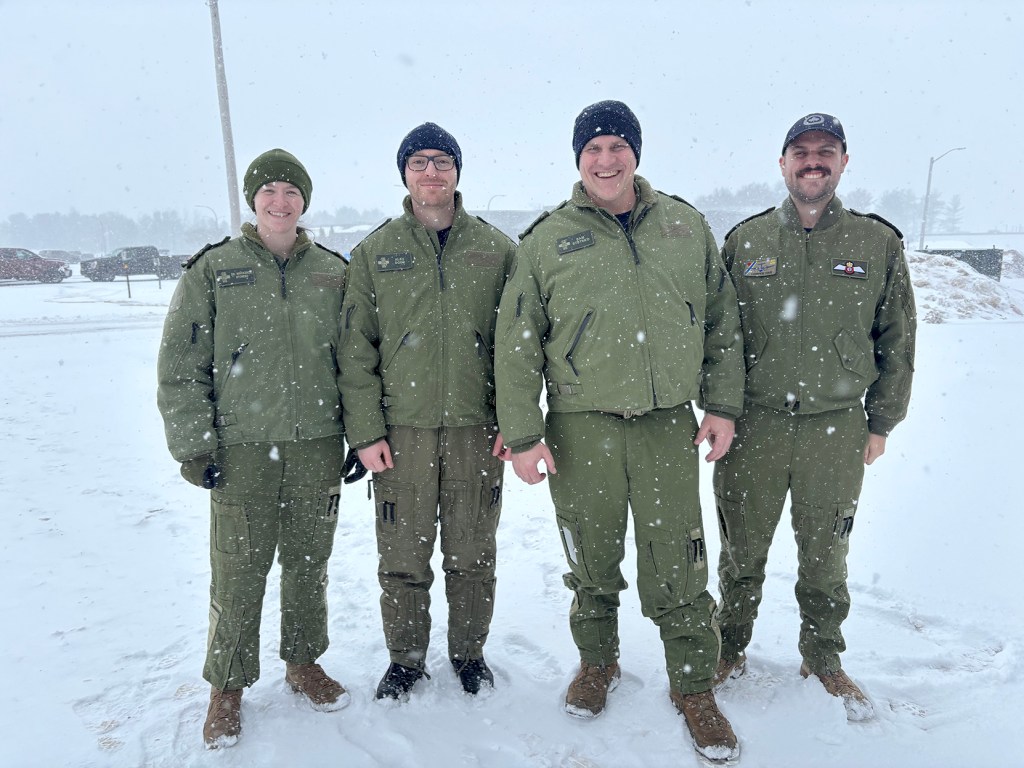
Day-to-day – and full career – work in an aviation environment comes with its own unique medical conditions. Three prospective military flight surgeons visited 14 Wing Greenwood recently, their last “field trip” before being fully credentialed in the specialized trade.
All doctors, Captain Mackenzie Stoness, Alex Dodd and Major Sam Stetsko were a week out from the last of the training required to become flight surgeons. The 14 Wing tour February 21 to 26 was an opportunity to get eyes on the workspaces of the people they will treat, and ears to some of their experiences. Their week included tours and conversations with technicians in maintenance and tool control sections, orientation on safety equipment, standards and procedures aboard the wing’s aircraft; a visit to 24/ 7 operations in the air traffic control tower and both static and in-flight experiences aboard the CP140 Aurora, CH149 Cormorant and CC295 Kingfisher aircraft.
During a static tour of the Aurora, Stoness said the “physical and mental stress you go through in flight” would be some of what the flight surgeons would be looking to hear about.
“Oh, there is a lot to talk about,” said 405 (Long Range Patrol) Squadron Captain Vince Lausoontornsini.
“I’ve spent my whole career with the Aurora – as a technician flying with it, and now as a pilot.
“There’s stress, there’s sleep – the quality of or lack thereof. We fly in the hottest of hot, and next we go to Yellowknife. A crew day could be 16 hours: we try to keep to 14 hours, but we can push to 18 hours with a commanding officer’s approval.
Everyone’s smart enough to try and get to bed at a good time, but it’s hard to get good, quality sleep: there’s coffee, energy drinks and you eat something, ‘cause we all have kids, dogs.… We’ve got to fly a plane.”
The Aurora is known for its overhead juts and edges – ready to catch flight crew and ground technicians’ heads. There is no running water onboard, fridge and freezer space to keep food is negligible, and the aircraft is almost always loud: parked on ground power for systems and ventilation, in the air on four engines, and through headset radio and radar noise.
“How is the turbulence in the back of this,” asked Dodd.
“Awful,” said Lausoontornsini.
Corporal Emma Hogenbom is an airborne electronic sensor operator, working mostly in the rear of the Aurora.
“Part of my job is to load sonobouys: I face forward, turn and grab a sono, turn and drop it,” she said, demonstrating the pivot-in-place movement she makes as the aircraft flies forward, banks, changes speed or manages turbulence. Sonos are most often dropped at low altitudes, where turbulence and oscillation magnifies from the front of the plane to the rear (recall the back seat from your school bus riding days). Lausoontornsini says cockpit crew try their best to radio the rest of the crew, “turning, 2Gs coming…,” but Hogenbom says, “there are lots of bruises.
“A lot of people in the back of the plane are on motion sickness medications. High altitude, usually I don’t need them; anti-submarine warfare (ASW) flights, we’re low – I take the meds. I’m not sick every time, and some people will take a half-dose or wean themselves off them as they get used to flying. But – the Aurora is older, it’s not as serviceable, and there’s not enough flights sometimes to get used to it. You don’t want to feel sick and affect the work. By the end of a mission, you’re tired and want to go home.”
All of this kind of feedback helps the flight surgeons help military personnel in clinic visits, ensuring, as at 14 Wing Greenwood, the “Operate as One” mission motto is met.
“I was looking for this teamwork,” says Stetsko, who only joined the CAF three years ago.
“The common route is Regular Force, med school, become a general duty medical officer, and a base decides then need a flight surgeon and send you away.”
Stetsko was a direct entry, coming from an anesthesiologist career in Alberta. Through the COVID-19 pandemic challenge, he found himself remembering the team and job satisfaction he experienced as a civilian doctor in Afghanistan in 2007, alongside the CAF. He joined in 2023 and now works in critical care and air transport in the Canadian Army, in Edmonton.
“Becoming a military flight surgeon legitimizes my certifications.”
https://forces.ca/en/career/medical-officer