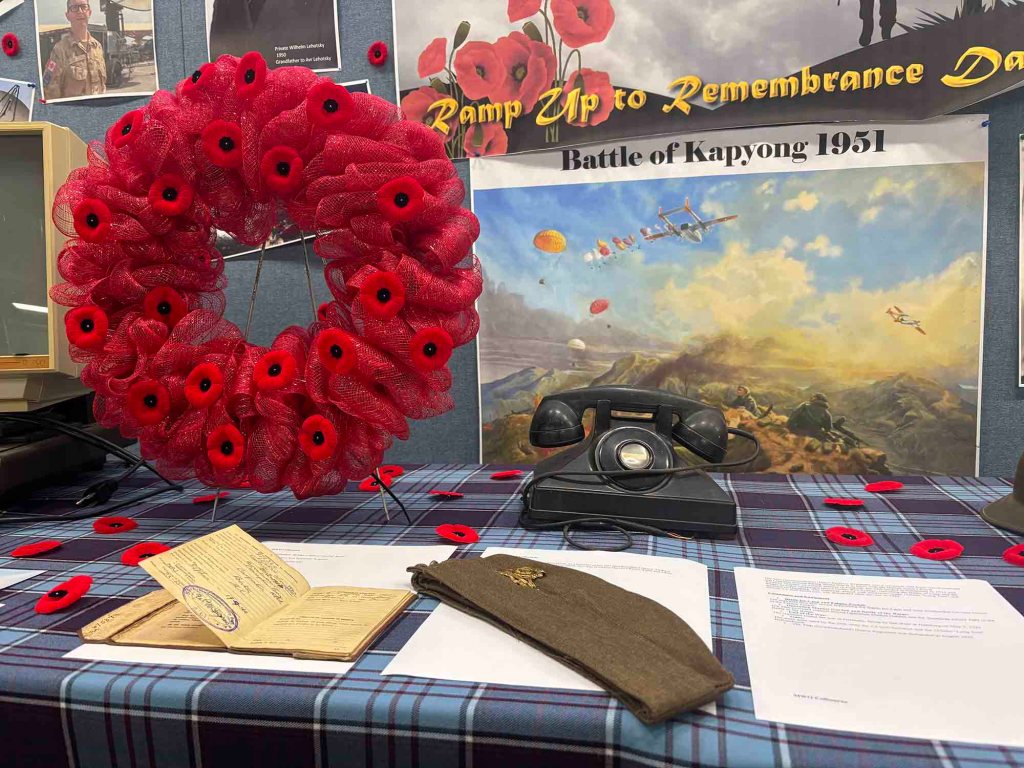
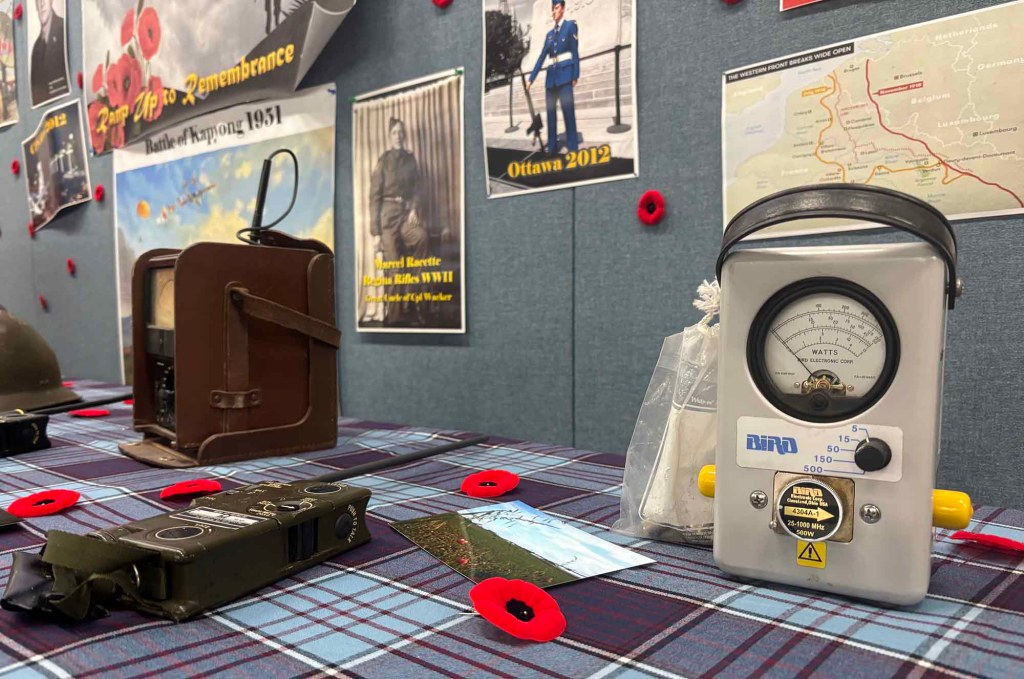
Personal mementos and gathered heritage on display in the middle of 4 Hangar’s workspace help members of 14 Wing Greenwood’s Communications and Information Systems Flight learn more about the reasons for Remembrance Day.
In the flight’s third “Ramp Up to Remembrance” effort, which includes the Fall display and a variety of Thursday morning briefings, CIS Flight members are reminded to “make time every year around Remembrance Day to be mindful.
“It’s important,” said Major Chris Collins, CIS Flight officer commanding, October 9. “Take the time.”
He especially encouraged members to mark October 20 to 25 as the wider Canadian Armed Forces’ Communications and Electronics Branch anniversary.
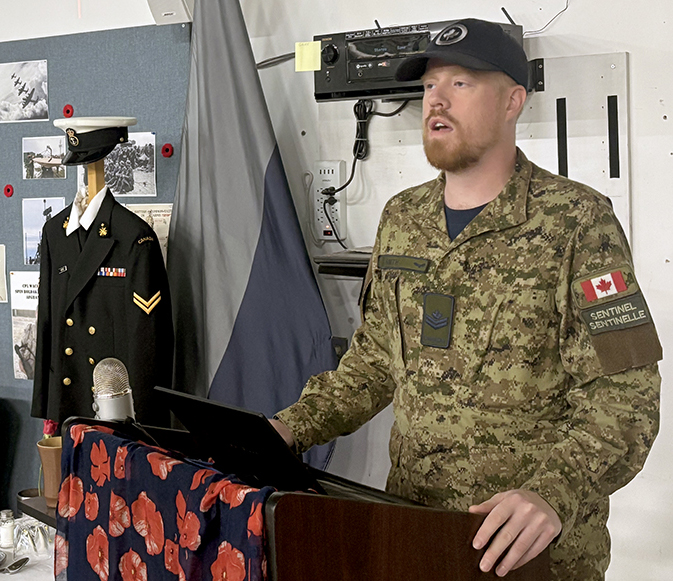
October 9, Aviator Mathew MacDonald shared the history of the poppy as a symbol of remembrance, rooted in the poppies that flourished in chalk-rich earth stirred up by the actions of First World War battles. The bright red flowers inspired Canadian physician Lieutenant-Colonel John McCrae to scratch out the poem “In Flanders Fields” in 1915, following the death of a friend in the Second Battle of Ypres. The poppy is now worn across the Commonwealth, made by veterans with donations accepted for veterans’ programs.
October 23, Master Corporal Chris Smith talked about Canada’s role in the War of 1812, with British and First Nations partners: “a very confusing war – a lot of battles won, but not meaning you’ve taken possession of the land;” and a war nobody wanted.
“The First Nations (led by Tecumseh) refused to give up lands to the United States, and wouldn’t fight against women and children. The British were not keen on war – their prime minister had been shot in May, and they were at war with Napoleon. The Canadians didn’t want it; the United States couldn’t understand: Canadians should be glad to be liberated from the British, and who wouldn’t want to join the United States?”
Smith highlighted turning-point battles with the Americans, including several communications issues. American militia became lost in the woods during their 1812 July invasion of Canada. Fort Detroit soldiers were tricked into surrender in August as British and First Nations forces marched in loops outside its walls to look bigger than they were. An October disaster, as Americans tried to take Queenston with just 13 small boats to cross the Niagara River, saw just half make the crossing, followed by their retreat from Queenston hill and 1,000 prisoners taken.
“There was confusion on the trail – no communications but colours, bugles and war cries as thousands of people marched through the woods – even firing on themselves.”
In 1813, Canadian hero Laura Secord travelled 20 kilometres through the wilderness to warn the British of an impending American invasion. In August 1814, with the bulk of American troops miles away, the British went up the river to Washington, forcing local militia and even the president to retreat as the city – and the White House – burned. In December 1814, the Treaty of Ghent ended the war between Britain and the United States, but news didn’t reach the United States in time to prevent a British defeat in New Orleans.
“The Americans won in New Orleans, and thought they won the war. The Canadians repelled the Americans, and thought they won the war. No borders changed in the treaty. And, the First Nations truly lost, with Britain, Canada and the United States dividing up their lands and deciding their future.”
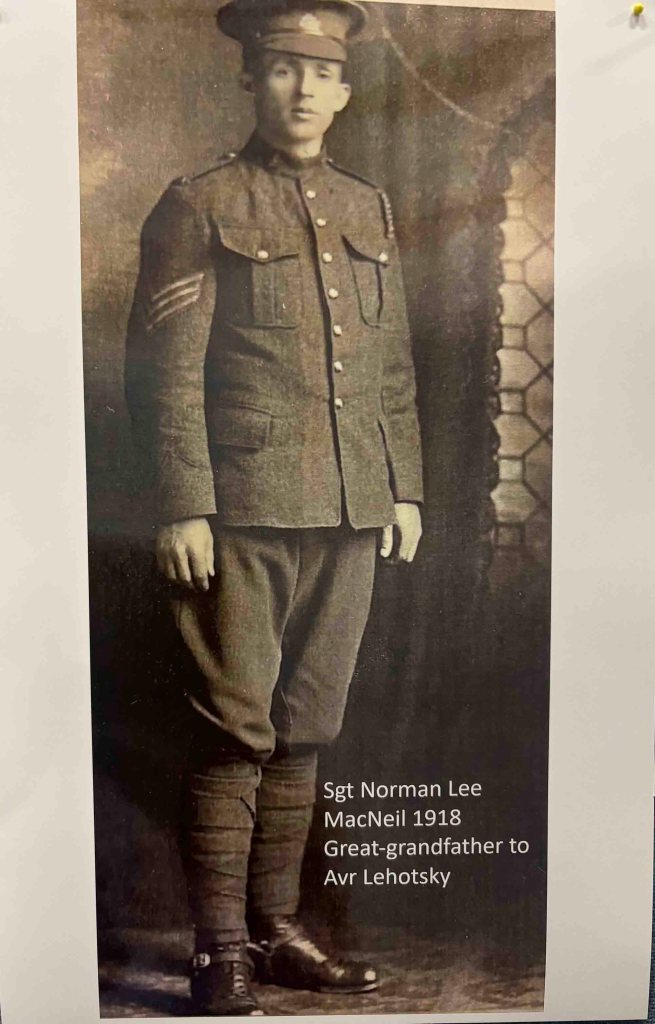
Severalother presentations in the Ramp Up to Remembrance series saw members share family wartime history and experiences, Canadian military facts of interest, and a description of the 1944 Abbaye d’Ardenne execution of 20 Canadian soldiers.
14 Wing Greenwood Wing Chief Warrant Officer Justin Harper, in attendance for Smith’s War of 1812 presentation, praised CIS Flight’s effort to develop the connection to history the “profession of arms” has, and how it is important to apply that history.
“The War of 1812: there are parallels – really easy to see today. It’s a reminder: the more you see in your career, the more you will see the same things – resources, power, national pride – drive us all.
“Remembrance Day is not about celebrating. It’s about remembering, and never forgetting. The First World War was such a traumatic event, and even though it was ‘never again, never forget,’ we started again. And, we’re right on a precipice again. That application of history is never more important than now.”