Family remembers a man ‘missing in action’
Eva (Keddy) Ogilvie, 94, can remember the day news of her brother, Oliver’s, loss on a Flying Fortress bomber mission January 6, 1944, came.
The family was sleeping in, a Saturday morning on their North Kingston farm.
“There was a knock on the door – before 7 a.m., and there was the telegram for Mum and Dad, that Oliver was missing in action. I remember that day. I was 14.
“We all loved him – couldn’t have enough of him.”
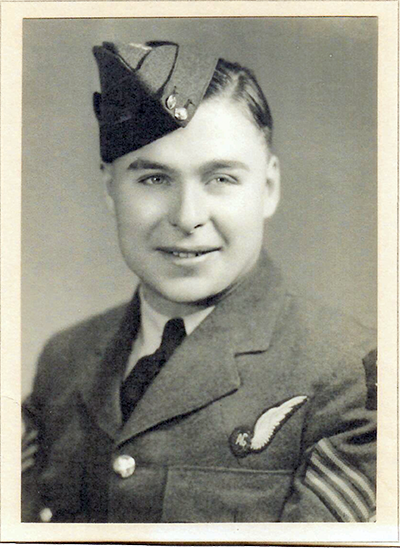
Royal Canadian Air Force Warrant Officer First Class Oliver Ambrose Keddy (R/88434) was born December 21, 1919, in Elton, Manitoba, to Reginald Keddy and Reta Keddy. Oliver was the eldest of five children. In the spring of 1938, Reginald was called to Greenwood, Nova Scotia, where his father, Henry, was very ill. Oliver – 18 years old, was left to run the family farm.
“He was great,” Eva says. “Oliver had done all the things he could on the farm, and he kept us all together.”
Reginald returned to Manitoba in October, with news the family was moving to Nova Scotia. Eva remembers it as a “lark,” all the family’s possessions sold or stuffed in a car and trailer and a month driving cross-country, before they arrived at her grandfather’s farm. Reginald and Oliver ran Henry’s farm until he died in December 1940, and worked seasonally in the nearby Kingston Evaporator Limited; Oliver worked as a dryer.
The construction of the Greenwood base, begun in 1940, eventually saw the family lose their farmland to the expanding airfield and move to North Kingston. May 14, 1941, Oliver enlisted in the Royal Canadian Air Force. His application details his occupation: “five years farmer,” with interests and abilities in running, jumping, baseball, football and reading mechanical books. He was 5’8”, with light brown hair, blue eyes and a fair complexion. He applied for air training, and was sent to Ontario to become an air gunner and wireless radio operator. He was presented his air gunner badge July 6, 1942. In November 1942, Oliver left Halifax for overseas service.
Oliver was a member of the RCAF task force stationed in Lagens, Terceira Island, Azores. The RCAF were present from the very beginning of the war, working alongside the British and American soldiers. Together, they got the small airports established to accommodate the larger bombers, notable the Flying Fortress, used to detect and destroy German U-boat submarines in the North Atlantic Ocean.
Such was the case January 6, 1944: Oliver, along with the nine-member crew of Fortress U/206 (206 Squadron, RAF Coastal Command) damaged submarine U270 sufficiently to force it back to its base – but not before the sub shot down the bomber. All nine lives were lost, including Oliver, the wireless radio operator on this ill-fated mission.
Reginald and Reta were told of the extensive search undertaken in the area where the last radio transmission from Oliver, and his aircraft, was received by command in Lagens. Early correspondence contained a note on the possibility their son might yet be found, as to give some degree of hope to the family back home in Kingston. The RCAF’s protocol for MIA personnel was to wait one whole year to pronounce members deceased. Oliver was declared “presumed dead” July 31, 1945. He was posthumously promoted to warrant officer first class, effective January 6, 1944. All his personal effects were returned home to the North Kingston farm: uniform pieces, two albums of photographs, toiletries, 50 handkerchiefs and 33 pairs of socks, a pair of swimming trunks, a “well-worn” pair of slippers, two woolen pullovers, a leather wallet and a homemade cigarette lighter.
Oliver’s name, along with 3,250 Canadian airmen, is inscribed on the stone reveals of the narrow windows in the cloisters and lookouts of the Runnymede Air Force Memorial in Englefield Green, Egham, United Kingdom. His name is also engraved on his parents’ gravestone in the North Kingston Cemetery.
Oliver died as a single man, aged 24. His parents, Reginald, died in 1979; Reta in 1994. Three of Oliver’s siblings – James, Muriel and Hughie – are dead. Eva, now living in Riverview, New Brunswick, had married a military pilot and their son, Graeme, Moncton; has Oliver’s medals. Eva has visited Oliver’s “beautiful” memorial in Runneymede once, bringing photographs home to their mother. Oliver’s brother, James, had Oliver’s logbook. James’ son, Robert (Bob), lives in Coldbrook. Bob’s son, Craig, lives in Cambridge. Craig’s son, Jamison Oliver Keddy, 20 (also the son of Sara White, this article’s co-author), lives in Cambridge.
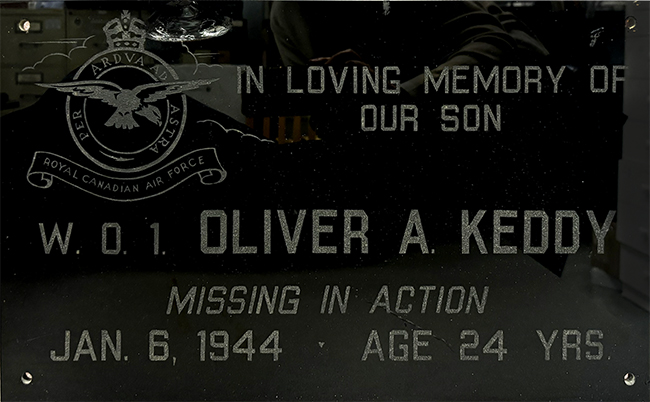
The Greenwood Military Aviation Museum holds a memorial stone for Oliver, once placed in the now-gone Greenwood Square community church, which disappeared as the CFB Greenwood airfield expanded; it may have also spent some time in the church’s old cemetery, now surrounded by hangars and runways. The museum is working to determine where the stone should be placed to best remember a local man’s military story.