CIS Flight members’ stories help unit remember in lead up to November 11
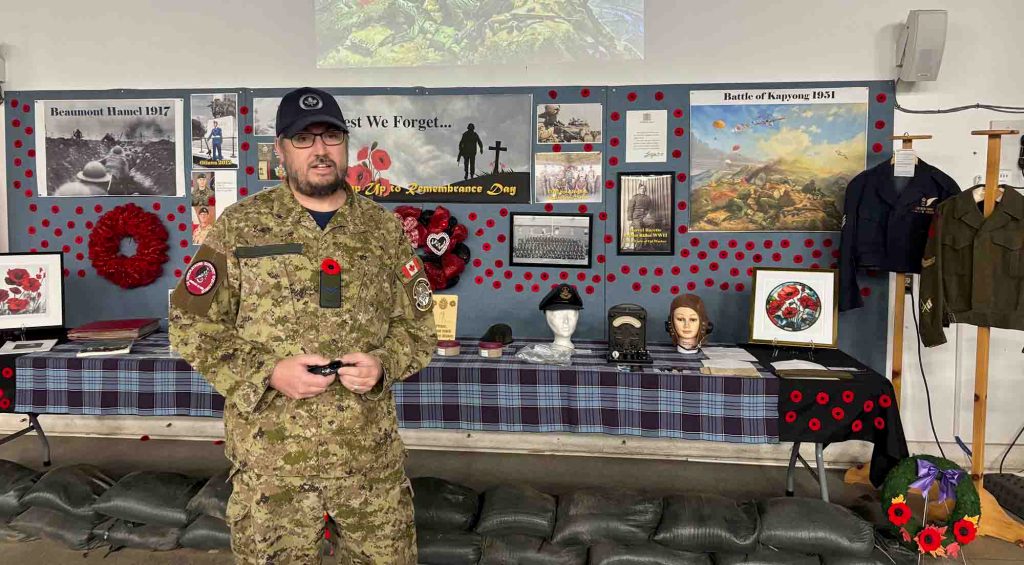
Linking current missions to past service happens often, as 14 Wing Greenwood’s Communications Information Services Flight members share stories through their now-annual Ramp up to Remembrance program.
CIS Flight Master Warrant Officer Rod Colbourne says the program is in its third season, replacing weekly safety briefs with military heritage in the six to eight weeks ahead of November 11.
Corporal JK Wacker, who deployed to Afghanistan in 2007/ 2008 with the 2nd Battalion, Princess Patricia Canadian Light Infantry; shared the 2PPCLI’s pivotal defence of Hill 677 in the Battle of Kapyong April 22 to 25, 1951. It was the first time a non-American military unit was awarded a United States Presidential Unit Citation.
“I was doing PT in Afghanistan, and I was wearing a 2PPCLI T-shirt, with that award insignia on the sleeve – that attracted the eyes of U.S. soldiers there; they didn’t know about the Canadian contribution,” Wacker said during his October 29 turn in the Ramp up to Remembrance schedule. “This is an often forgotten battle in a forgotten war.”
Twenty-five thousand Canadians fought in the 1950 to 1953 Korean War; 516 died, including 10 2PPCLI members killed during that three-day battle. A 20,000-soldier strong Chinese offensive overran the Kapyong Valley: they could have reached Seoul, pushing United Nations’ forces off the South Korean peninsula. The 2PPCLI and an Australian unit were on two hills on opposite sides of the valley, covering a six-kilometre front.
“The brigade was ordered to hold the Chinese off as long as possible. They put their World War II’ veterans’ hill and terrain experience in Italy to good effect, and dug in.”
Through heavy fire, and even hand-to-hand combat, the 700 Canadians held their hill, covered the Australians and, with their allies, saw 1,000 Chinese dead before their retreat.
“This allowed the United Nations forces to consolidate, and the battle contributed to the defeat of the Chinese forces and allowed the Korean forces to regroup.”
Wacker added, as the United Nations left Korea then, “peace is something that still very much eludes the Korean peninsula.”
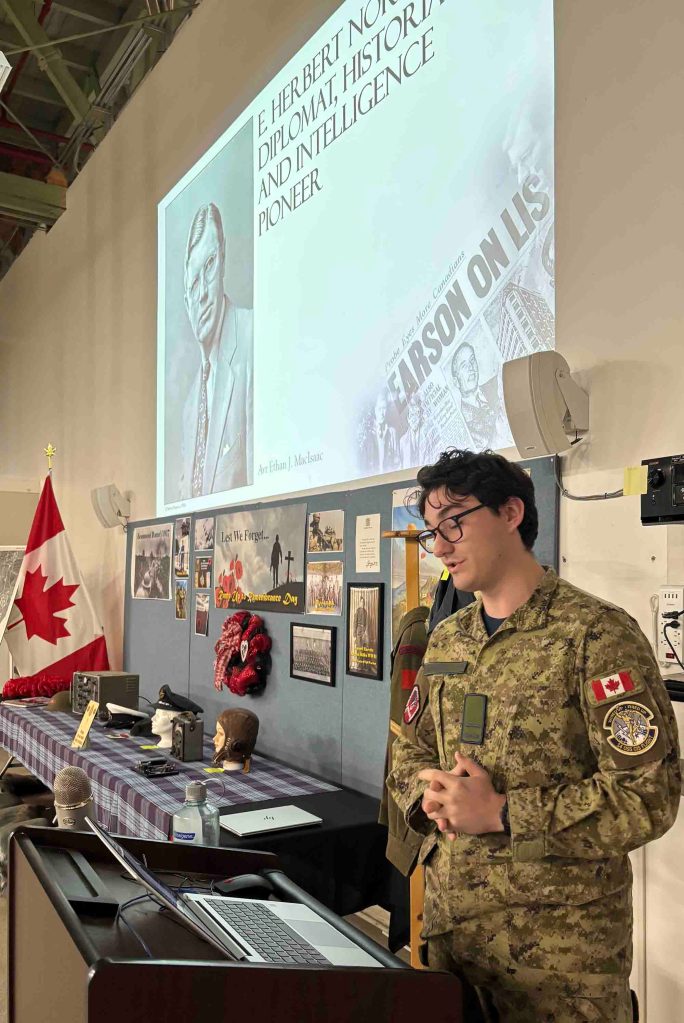
The work of diplomats has its role in international peace, politics – and even war. The goal is public service; but, there are often also costs. In his presentation, Aviator Ethan MacIsaac introduced Herbert Norman: “diplomat, historian, intelligence pioneer.
“His story still remains relevant today,” MacIsaac said.
Born in Japan to Canadian missionary parents in 1909, educated at Cambridge and Harvard universities, he became Canada’s “go-to” expert on Japan during the Second World War. He worked with the Canadian delegation in Tokyo before the Japanese bombing of the American Pearl Harbour, was interred and then continued to work in Japan after the war, becoming a top authority for the West on East Asia affairs.
Through the 1950s, though, Norman’s credibility was called into question in numerous American-led investigations during the “Red Scare” of Communism. An American Senate committee and the FBI “aggressively investigated” Norman through “an intense environment of paranoia,” MacIsaac said. The Canadian RCMP cleared Norman, who went on to serve in Egypt and Lebanon. In 1957, American “character assassination” and “intense scrutiny and slander” resurfaced and, in April, an overwhelmed and exhausted Norman took his life.
Norman’s contributions during the Suez crisis led to the 1957 Nobel Peace prize for Canadian Secretary of State Lester Pearson, emotional during a radio segment MacIsaac played during his presentation; Pearson calling Norman a “victim of persecution; one of the finest, most loyal public servants in the Government of Canada – and we shall miss him very much.”
MacIsaac said understanding people, their society and history is a prerequisite for diplomacy: “cultural knowledge, espionage skills and expertise are just as relevant,” from Norman’s time to today’s Canadian Armed Forces work environment.
“These presentations are good reminders for all of us,” said 413 (Transport and Rescue) Squadron Lieutenant-Colonel Greg Boone, visiting CIS Flight October 29 as acting wing commander.
“These are part of our heritage, and why we’re here doing what we’re doing.”