How museum sleuths cracked a 1911 Royal cold case
Jennifer Ross,
Collections manager,
Greenwood Military Aviation Museum
Imagine unrolling a piece of Canadian history so vast it takes up an entire room, only to realize nobody left a single note explaining where it came from.
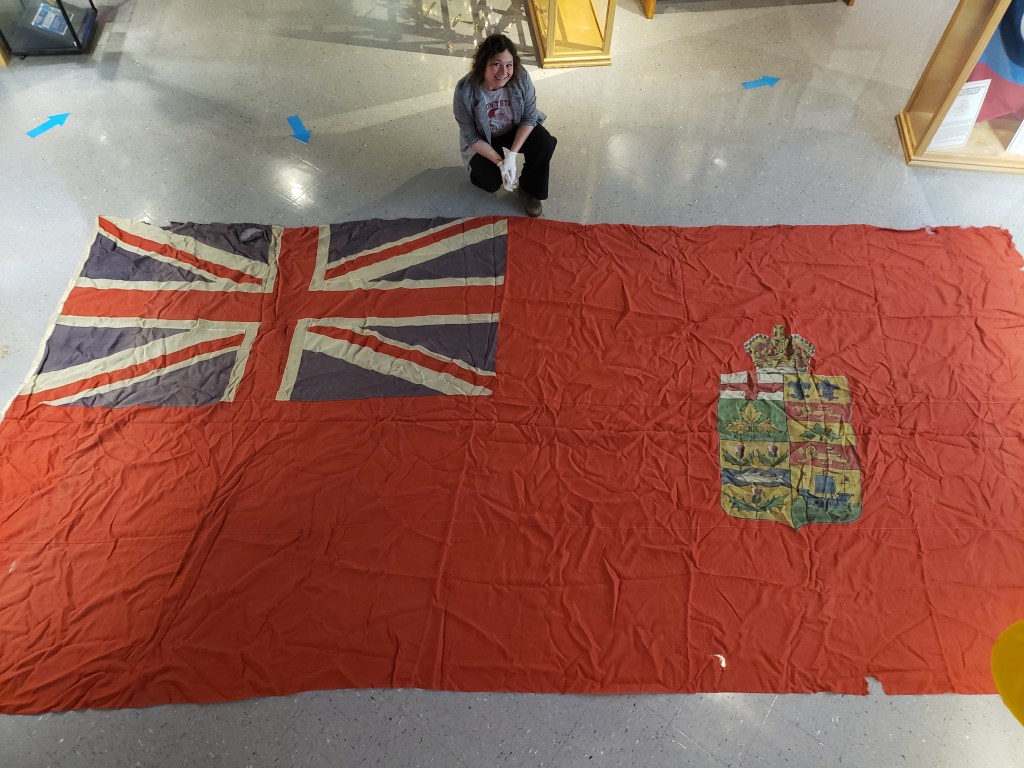
That was the tantalizing riddle sitting inside the Greenwood Military Aviation Museum, where a massive early 20th-century Canadian Red Ensign re-emerged, without a shred of paperwork.
Tagged in museum jargon as “Found in Collection” (FIC), the giant textile was a total mystery – no donor logs, no accession numbers, no archival records. Stitched onto its fly was a vivid patchwork of provincial seals, capturing a snapshot of Canadian heraldry prior to official standardization in 1921. Its sweeping scale proved it was built for high-profile duty atop a major public building, a towering flagstaff or a vessel navigating Maritime waters. Yet, without documentation, vital questions remained unanswered: where did it wave? Which community, landmark, or ship hoisted this giant banner? Why was it made? Was it raised for routine daily duty, or unrolled for a momentous occasion? Who preserved this heavy fabric, and how did it come to the Greenwood museum’s archive?
Without those answers, a remarkable historic witness turns into a silent relic. It stands as a vivid reminder of why provenance and museum record-keeping matter: preserving the story behind an object is just as vital as preserving the threads themselves.
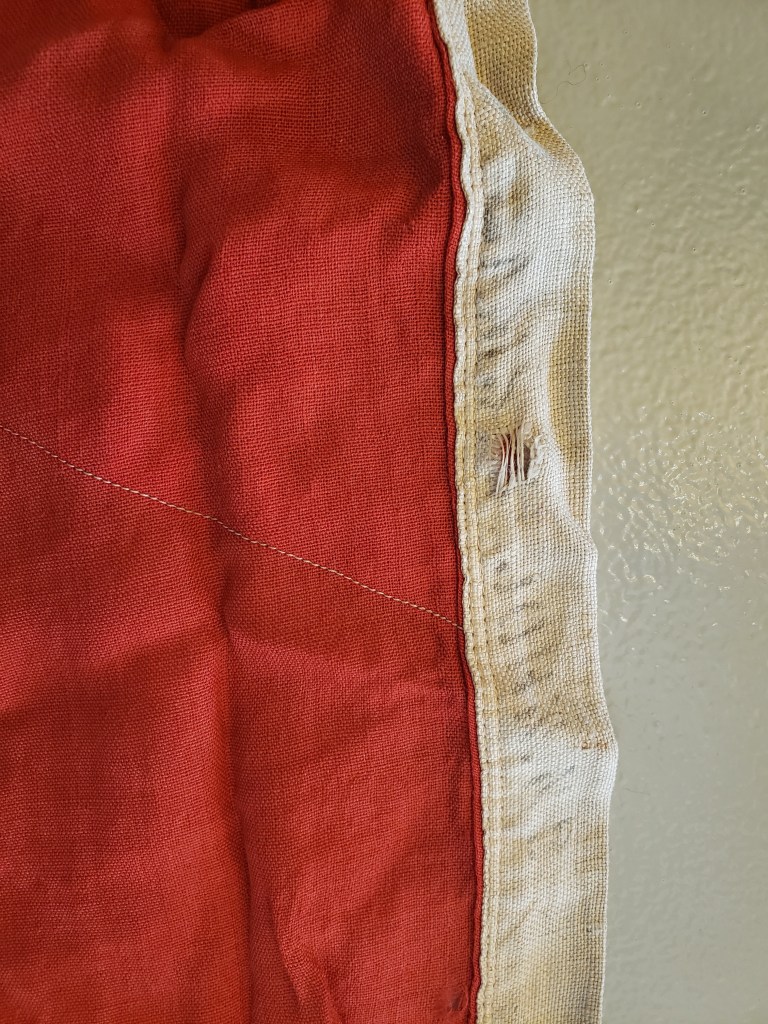
The clues were on the fabric. The breakthrough didn’t come from dusty file folders, but from a close inspection of the flag’s physical construction. Stenciled vertically along the thick white canvas hoist in faint, dark lettering: “St. John, NB.”
That single geographic mark prompted the flag’s recent transfer to the Canadian Military Engineers (CME) Museum in Oromocto, New Brunswick. There, museum professionals cross-referenced records and archives with the flag’s unique heraldry, finally unlocking its past: the flag was created in 1911 to celebrate the coronation of King George V in Saint John, New Brunswick.
Even though the paper trail was lost, the combination of physical evidence and historical research helped museum sleuths restored the artifact’s lost voice. What began as an anonymous, silent relic is now celebrated for what it truly is: a direct, historic witness to a grand royal milestone in Maritime history.