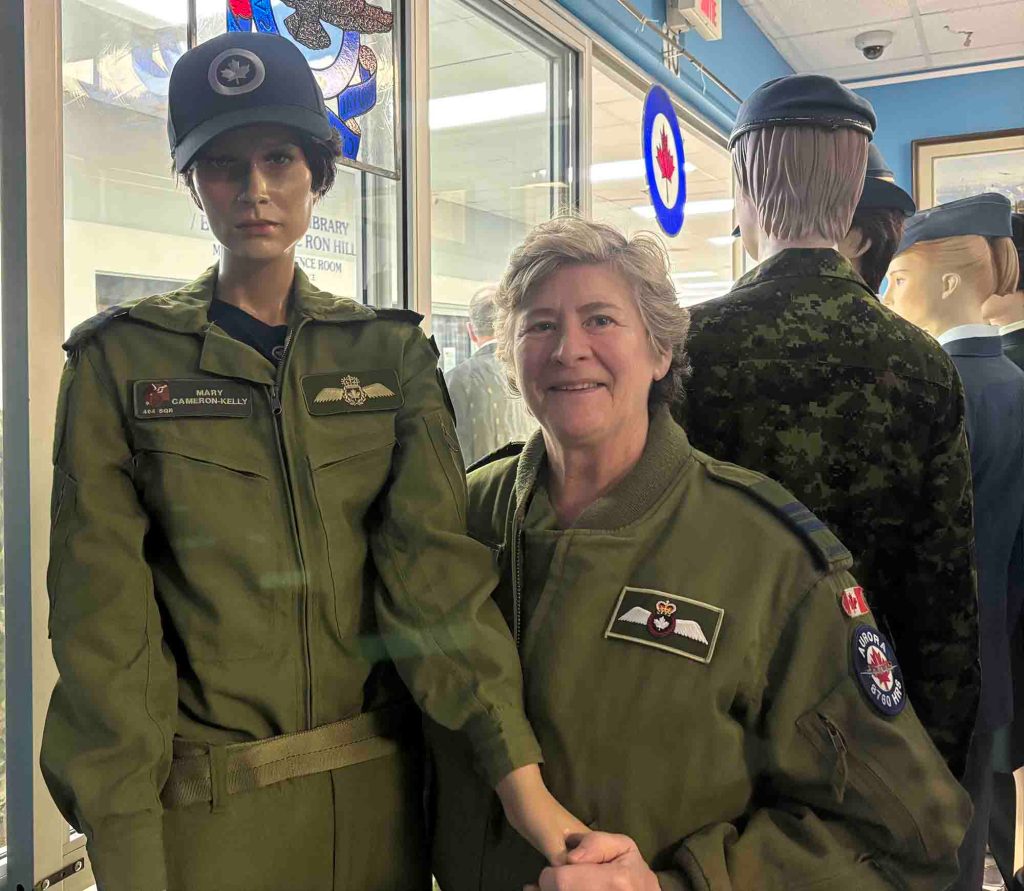
Museum display highlights service wear through the decades
Since the Second World War’s Royal Canadian Air Force’s women’s division, women have been “an essential part of Canada’s air power,” said 14 Wing Greenwood Commander Colonel Luc Vachon, formally opening March 13 a collected display of the Greenwood Military Aviation Museum’s women’s military uniform through the decades.
“We’ve got the uniform, but it’s also a display on the evolution of women’s roles in the military and the progress of the institution: more than just a display of clothing.”
Vachon said the women’s division’s earliest service, in many roles that allowed men to go overseas, “proved far more enduring.
“Over the decades, barriers continued to fall, with women moving into every operational role in the air force – and throughout the Canadian Armed Forces. In Greenwood, we have women in every position and role – flying and enabling, training and leading, in maritime patrol, search and rescue and mission support: all of it outstanding support.
“The strength of the RCAF lies in diversity, talent, depth in ranks – and women are part of our air power. To the women who have served before us, serve now and will serve: thank you for your service.”
GMAM collections manager Jennifer Ross said the museum is deeply grateful to military members and veteran families who donate items for use in displays, “all personal history that remembers women’s legacy in the RCAF.
“To those who have served, a uniform becomes a second skin. They carry the weight of duty and the story of a changing nation. Each uniform on display represents a barrier broken and a standard of excellence maintained.
“This is more than an evolution of style; it is an evolution in identity.”
Museum volunteer Major (retired) Bob Johnson led the uniform display, gathering uniform pieces, accessories and more from the GMAM’s own collection and hunting down missing elements to complete the looks, and then adding descriptors to the range of mannequins now standing in the museum’s welcome window. The uniform series moves through the decades from the 1940s, including styled wedge hats, classy two-piece battle dress “Eisenhower” jacket and trouser sets, an early nursing uniform, the 1950s’ and 1960s’ “TWs” – tropical worsteds, the post-unification rifle green issues uniforms and, in 1986, “back in blue” Air Force pieces trimmed in the “old gold.” Johnson worked to include both officer and non-commissioner members’ versions of each uniform. The final mannequin set features the more familiar CADPAT – now “old” itself.
The display is visible during both museum open hours, and when it is closed, with its hallway-facing placement. Once you’re inside the museum, further servicewomen – at work and in uniform – may be found included in the more fuller displays. Come Fall, many of the display mannequins will move back to their previous positions around the museum, with the newer representations joining them where best placed.