Paralympian shares ups, downs of life ‘at the top, bottom of the mountain’
A leg amputation, addictions, depression; three Paralympic appearances – including a gold medal finish, recognition by a Canadian prime minister and fast friendships.
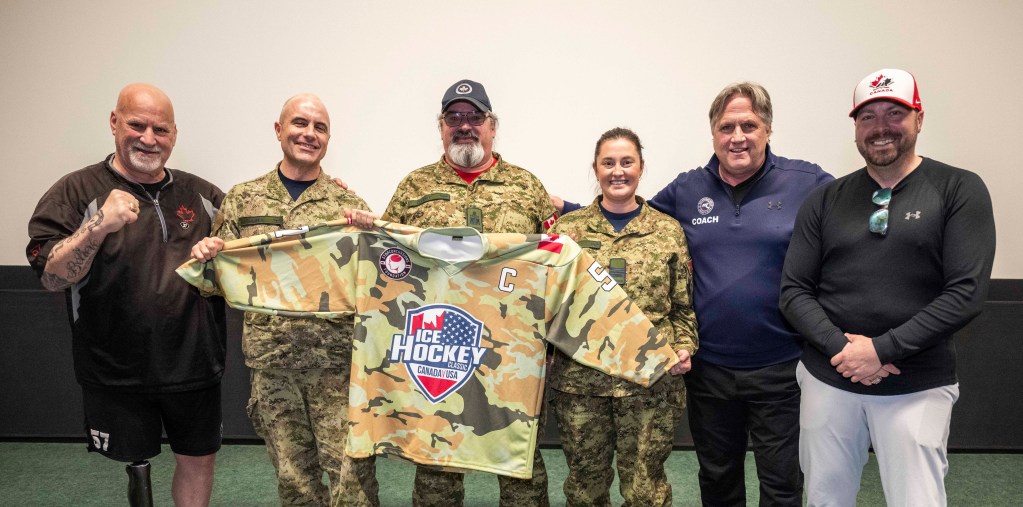
“I wouldn’t change a thing – good and bad, I’ve learned from it,” said Paul Rosen, a guest at 14 Wing Greenwood November 21. With friend Kerry “Gouche” Goulet, the global director of Stop Concussions and the head coach of the Melbourne Ice; the men helped the wing’s Defence Advisory Group for Persons with Disabilities share a message of resilience in advance of December 3’s International Day for Persons with Disabilities.
Rosen shared his journey from a teenage hockey injury that shattered his leg, through almost three decades of surgeries, addictions and lows before his leg was amputated in June 1999. Just a few months later, a 12-year-old buddy he met in rehab, coincidentally from his own hometown of Thornhill, Ontario; convinced him to come play sledge hockey with him.
“’Sure!’ I said,” Rosen said. “They needed a goalie, they set me up, I played the game. We were outshot 53-3, but we only lost 1-0. A phenomenal start.”
In short order, he made the Canadian team and played at the 2002 Salt Lake City at age 41, and then the 2006 Torino, Italy, and 2010 Vancouver; Paralympics. When it was over, he was 50, retired from the team with no more Sport Canada funding, divorced, heavy into addictions.
“I woke up one morning, and I didn’t see myself as anything else.
He joked about his unsuccessful attempt at suicide, but time in hospital helped him start to rebuild his life. In 2013, when Prime Minister Stephen harper selected him as one of 17 recipients specifically honoured with the Queen’s Diamond Jubilee Medal for his work as a disability advocate, and despite having just $42 in his bank account, “I felt phenomenal!
“I started to do some other things in my life; I wanted the little boy or girl in Corner Brook or Greenwood to know they could be disabled and play in the Paralympics. All I ever wanted was to be treated as equal: win or lose, at the top of the mountain or at the bottom.”
In 2019, in another of the “black holes” that plagued him, Rosen found out what “anybody here who’s had a mental health battle knows: you can’t survive – you just can’t – without good people in your life.”
His daughter called long-time friend Goulet repeatedly and, when Goulet knew Rosen needed support, “he sat by my bedside until I got out of the psych ward and into rehab.”
The men launched the “Gouche and Rosey show” and got through the early COVID-19 years together, sharing their hockey stories and international travel experiences in what’s now over 700 episodes.
“’Never give up.’ That’s the meaning of my life,” Rosen said. “There are still days I wake up with demons knocking on my door, but you have to – you have to – get that help. You have to have a friend.
“I’ve been at the top of the mountain many times, and I’ve been at the bottom many times. The view from the top is way better. I’ll keep climbing ‘til the day I die.”
Goulet shared a few short remarks after Rosen’s main presentation, crediting his friend for “greatness” in showing and sharing his vulnerability. The men’s different lives in hockey turned into passports around the world, but Goulet said, “it’s what we see along the journey.”
Para PowerPlay offers all a way to play
Para PowerPlay is breaking down barriers and making sport accessible for everyone – including in Greenwood. Thursdays at 9:30 a.m., 14 Wing Greenwood military members are welcome to try sledge hockey at the Greenwood Gardens Arena. Open sledge hockey opportunities are planned at community rinks across the Valley in coming months. Find out more at parapowerplay.ca