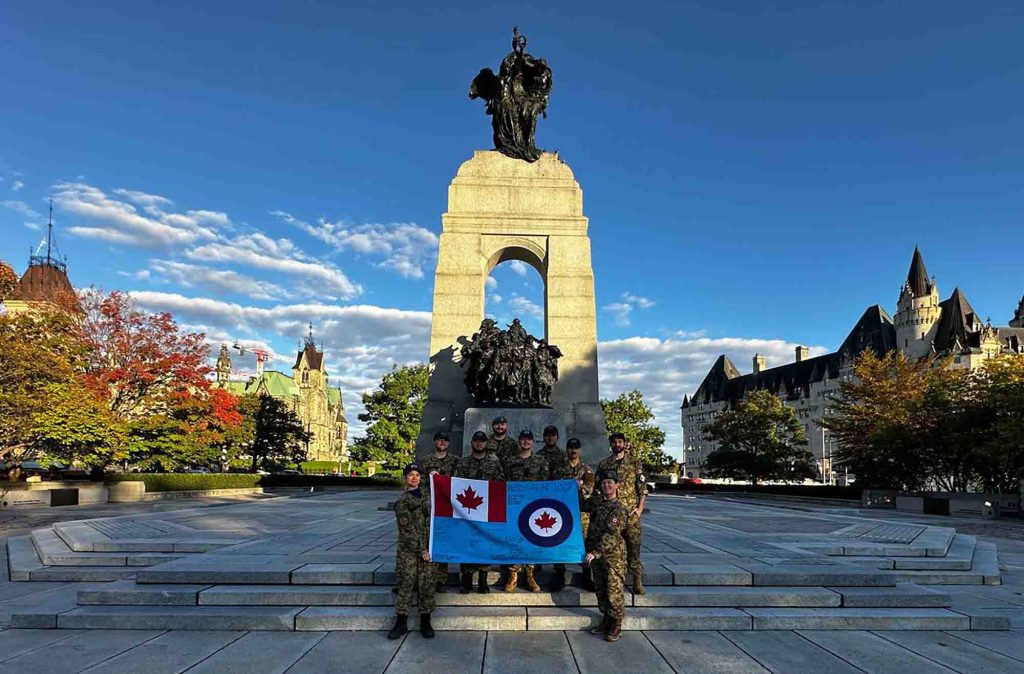
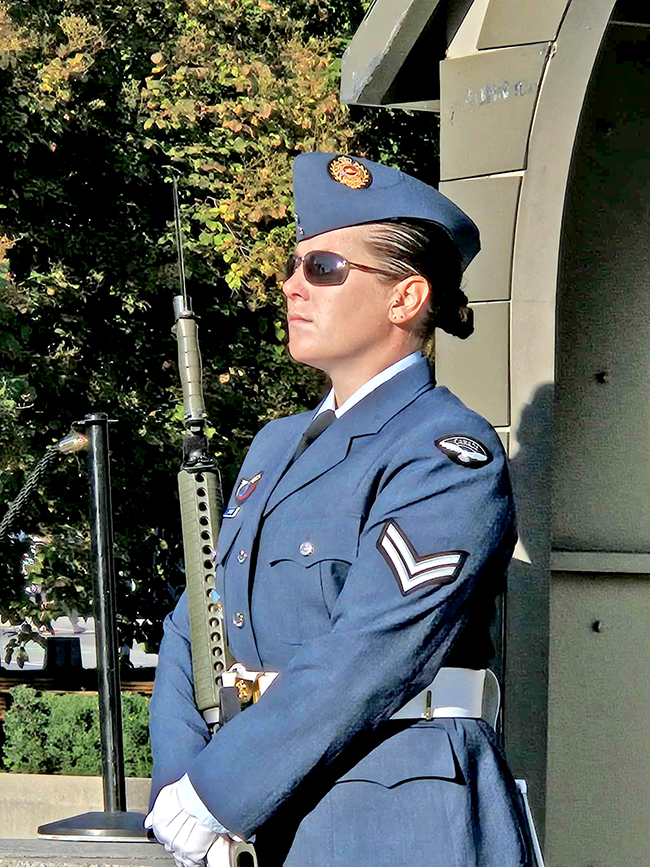
It was all Corporal Madison Cairney could do to keep a straight face on National War Memorial and Tomb of the Unknown Soldier sentry duty: a little girl, “super cute,” was watching her stand, and then patrol across the grounds, from behind her mother’s legs.
“Every time I went by, she’d be tucked behind, or she’d be out in front of her mother and then go back behind and, by the tenth pass, she was staying out in front watching me,” Cairney says. “We’re not scary!”
Cairney says the number of children, passers-by and visitors to Ottawa from across Canada and around the world were a highlight of her five-week experience with the Canadian Armed Forces’ National Sentry Program.
“Part of every day’s work was an hour outside the memorial, talking to people, answering questions – and taking tonnes of pictures! If I go on Snapchat, and people post to a certain location – sure enough, there we are. It’s pretty cool that anyone can see that, just from people taking pictures on vacation, maybe. I could have been the only Canadian soldier they saw. That’s eye-opening.”
Cairney is a water, fuels and environment technician at 14 Mission Support Squadron. She’s been posted to 14 Wing Greenwood for the past two years, and has been in the military for four years. She learned in April of the opportunity to volunteer for national sentry duty and, with chain of command approval, applied.
“I grew up doing an extracurricular sport called Colour Guard – all choreographed routines with flags, rifles and sabres. And then I always wanted to join the military. I didn’t know what I wanted, it was during COVID and I was working in a car plant. I applied for the military, and WFE tech was one of the options. Now, I wouldn’t want to be anything else. I made the right choice.”
National sentry duty was Cairney’s first formal parade duty since her basic training: “I loved it.
“It reminded me of Colour Guard, and why I wanted to join the military in the first place. I needed to have two sets of DEUs ready, and boots to standard. They provided all the ceremonial whites, and week one was all training – not hard, but outside all day and some stuff I haven’t seen since basic.”
Cairney was part of an all-Royal Canadian Air Force rotation, taking a dedicated September turn to highlight the RCAF’s connection to the Second World War Battle of Britain. She’d stand sentry one hour twice a day, making a mental game of tricking herself on how much time had passed and how much time remained every hour, as the hot weather and direct sun added to the experience.
“I’d do it again in a heartbeat. My Grampa was in the Second World War in the air force as an aircraft technician, maybe three or four years. I’m the next person in our family to be in the military. This was something else – very rewarding.”