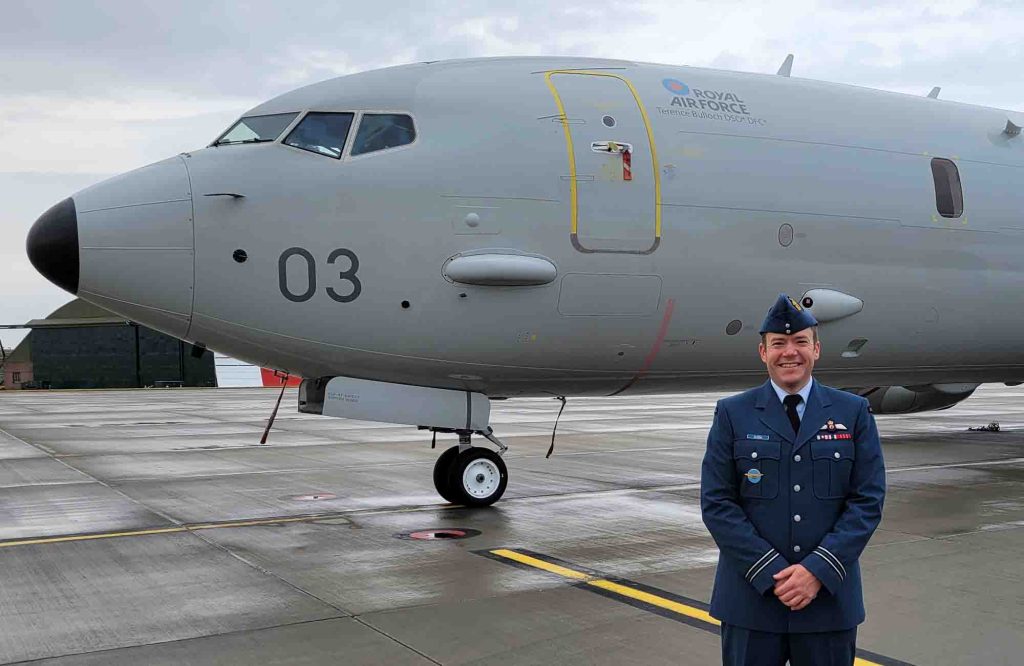
A year has passed since the Royal Canadian Air Force (RCAF) sent its first four aircrew to the Quick Reaction Alert Station, Royal Air Force (RAF) Lossiemouth in Scotland, for P8A Poseidon maritime patrol and reconnaissance aircraft exchange training. The selection of the full eight RCAF candidates, from 404, 405, 407 and 415 squadrons; was a measured approach, ensuring Canadian operational squadrons could maintain CP140 Aurora units’ responsibilities with “SEEDCORN” members away for training.
“The members were selected because they were very competent, and showed a lot of promise and potential,” says the RCAF’s SEEDCORN lead, Captain Darren Kirk. “It was the right mix of experience and leadership while, at the same time, not causing a detriment to the frontline operations at home – because operations are continuing.”
Some SEEDCORN candidates were selected from their first operational tour, with optimal malleability to changes in procedure; others, like Kirk, already part of the 14 Wing Greenwood Transition Team for the RCAF’s soon-to-arrive P8 platform, come with experience. That mixed background will help all RCAF members meet the first challenges of the exchange program, and then bring key operational data back to Canada, helping to set the stage for the RCAF transition to the Poseidon.
Among the first exchange challenges was establishing a comprehensive, 60-day RAF pre-employment training package.
“It’s not like you’re just going on vacation – you’re moving here,” says Kirk. “So: wife, two kids, car seats, strollers, plus six bags to get you covered for what ended up being almost two months before our stuff arrived.”
42 Torpedo Bomber Squadron Wing Commander Colin Bostrom and Lossiemouth’s HiVE, an organization similar to 14 Wing’s Military Family Resource Centre, were instrumental in getting Canadian families settled.
“The support and excitement were sensational,” says Kirk. “It helped alleviate the arrival of the first handful of us, and then, once the first four were here, we could sort of take over and help the next four that came.”
The RCAF’s SEEDCORN team, named after the United Kingdom’s own maritime patrol experience retention program after the 2010 cancellation of its Nimrod MRA4 aircraft, will help qualify the first RCAF Poseidon crews and provide operational experience before the new planes arrive at 14 Wing Greenwood in 2027.
“It’s part of the curriculum,” says Kirk. “You have to go away and do a deployment and train in a different area. Poseidon Conversion Course (PCC) 13 went to United States Navy Naval Air Station Sigonella.” There, PCC 13 trained alongside U.S. Navy P8s and Greek Navy submarines, which Kirk found particularly beneficial.
“While on course, you actually did some real-world submarine warfare stuff, some real-world multi-asset training. And that’s huge for all crew members.”
The PCC course offered by 42 Squadron takes approximately nine months. SEEDCORN students then transfer to either RAF CXX Squadron or RAF 201 “Guernsey’s Own” Squadron, where they move from low combat ready to combat ready. Through it all, the Canadian exchange members provide the RAF with multi-tour operational aircrew, and get the chance to disseminate some RCAF corporate and operational knowledge with allies.
“One of the big points and draws of these exchanges is to share how people do things,” says Kirk, “and, if you can pick up improvements in the way you do things, then you’d be silly not to onboard those better habits. It’s meant to be a collaborating thing: they’re providing us the operational exposure on the airplane, and we can maybe put out our take on how you might do something.”
Although the RCAF has planned 10 conversion courses with the U.S. Navy, the U.K.’s assistance through the SEEDCORN exchange program has been a huge help in fast tracking the RCAF’s maritime patrol platform transition.
“It was really the RAF leaning forward, coming to us to say, ‘We can help,’” says Kirk. “It was basically paying it forward from when the RAF SEEDCORN members were with us in Greenwood for eight years.”
Collaboration between the Canadian aircrew and their British hosts extends into the classroom, where the RCAF students are encouraged to take part in debriefings and presentations.
“They’ve been very good at letting us offer things or talk about things,” says Kirk. “It’s a balance. Right? You’re a student, but the instructors also recognize you can provide some extra value.”
For Kirk, the collaborative atmosphere in Lossiemouth is a major benefit, particularly in fostering camaraderie between allied forces, but also among the trades that make up full aircrews. During the training’s ground school, all trades learn together before breaking off. The curriculum also includes an observer phase, before students reconnect in simulated missions. The diverse, full team learns from each other and builds rapport, strengthening a culture of mutual respect, teamwork and open communication. That helps assure mission success during future operations.
“It’s a good, common-sense approach,” says Kirk. “When you can see everyone else’s issues, then it means you have a better understanding of what’s going on. The crew understands more. The whole crew just has this dynamic that exudes competency and professionalism.”