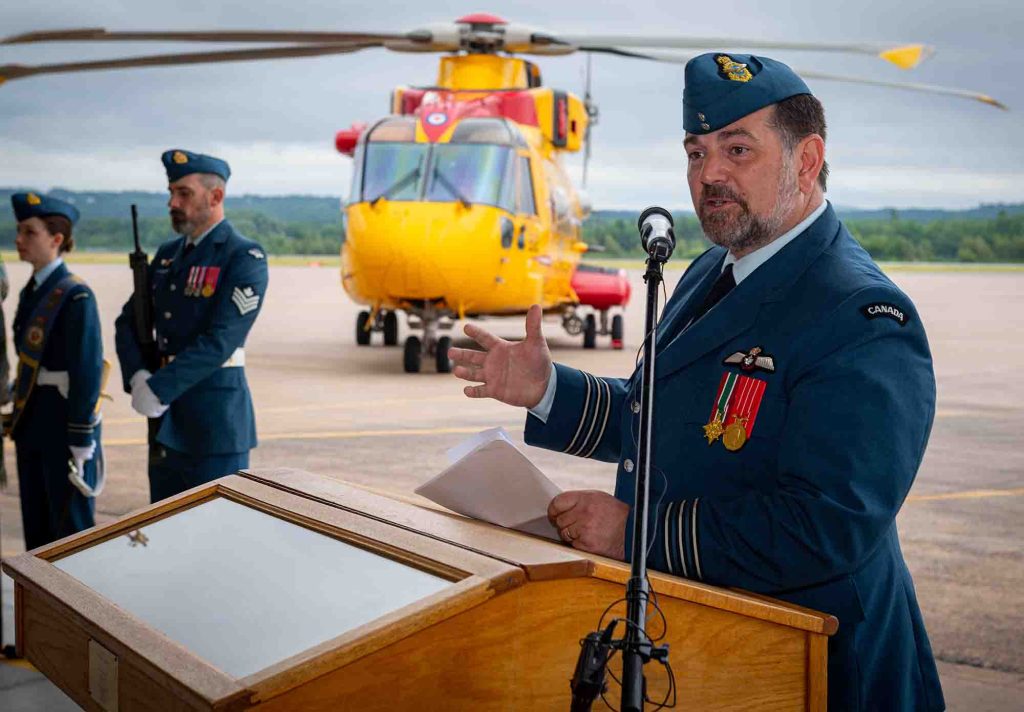
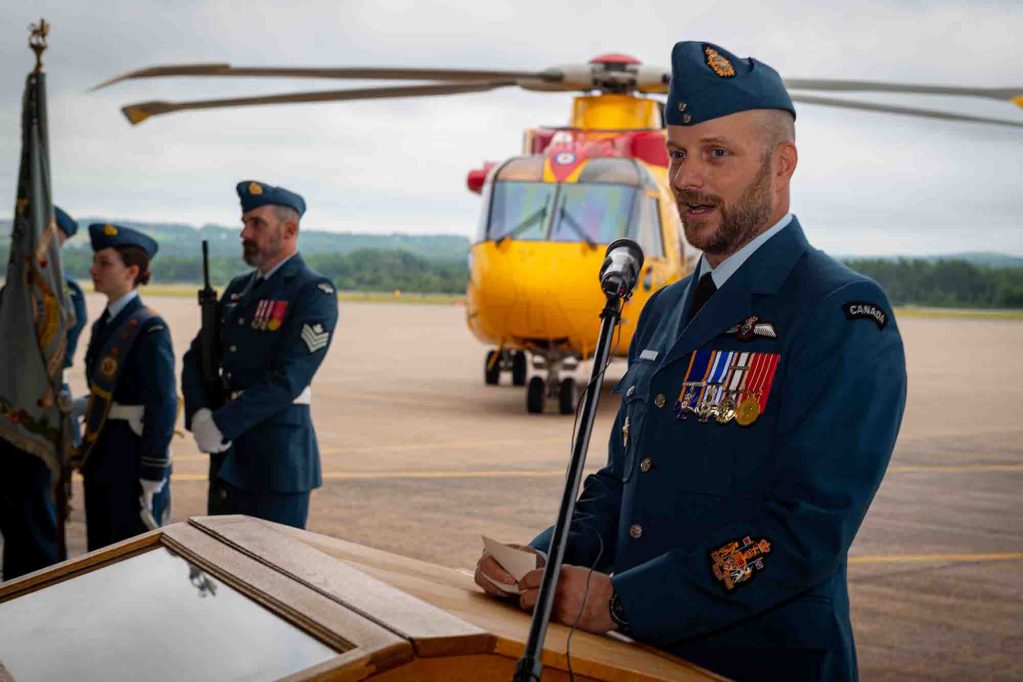
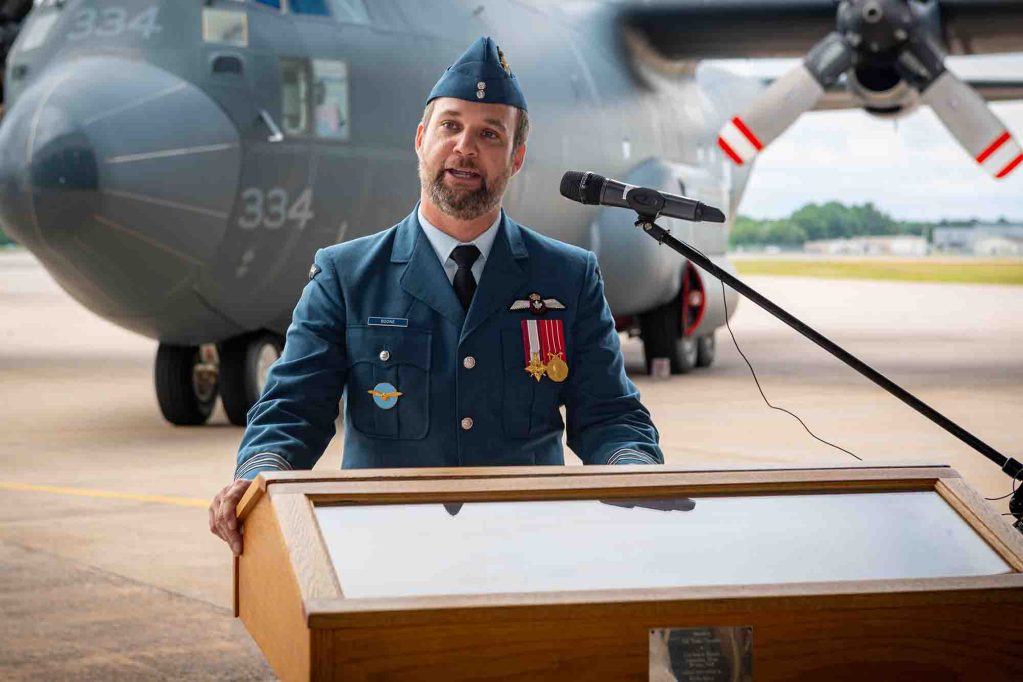
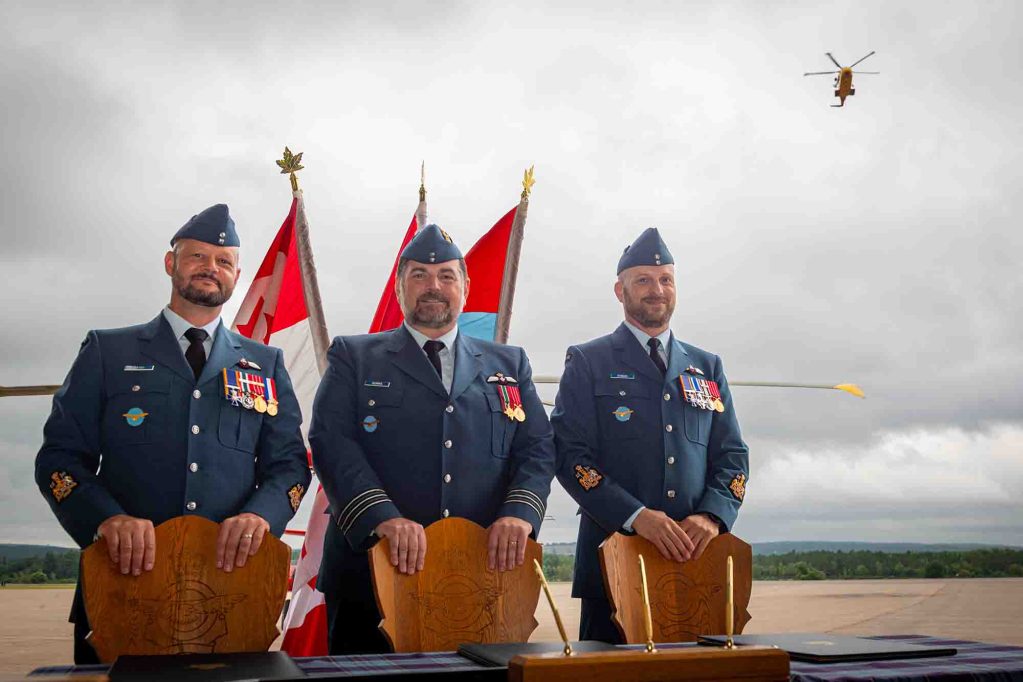
The heart of 413 (Transport and Rescue) Squadron was front and centre July 18 – and overhead, in the low fly-bys of both a CH149 Cormorant helicopter and a CC130 Hercules, as Tuskers marked a full changeover in its command team from the 14 Hangar floor.
Chief Warrant Officer Damien Robison warranted the Cormorant pass, as he turned his responsibilities over to the incoming Chief Warrant Officer Bryce Culver. Lieutenant-Colonel Mark Norris grinned from ear to ear as the Herc went low – and fast – overhead, as he and the incoming Lieutenant-Colonel Greg Boone finished signing their changeover documents.
Chief’s role, responsibilities benefit from SAR-Techs’ experience
Robison took on chief’s duties almost nine months ago, upon the retirement of Chief Warrant Officer Stephen Bates.
“It was a big learning curve, but it’s not what you know – it’s who you know, and there was always someone to ask,” he said. “I’ve been blessed. I wasn’t expecting this, but I was trusted to be the chief of a search and rescue squadron – the best squadron in Canada. Now, I get to go back ‘downstairs’ and do my job as a SAR-Tech.
“And, yes, I would do it again.”
Culver, a coursemate of Robison, commended Robison for “stepping up to the plate – and he did an amazing job. I can see that as I walk around the squadron.
“I am grateful for this opportunity. I see lots of familiar faces; and I will give you the space to do the job you know how to do.”
Norris made a point of commending the CWO line of Bates, Robison and now Culver for their SAR-Tech trade representation in recent years.
“Chiefs embody our level of professionalism, the Canadian Armed Forces’ ethos and are the guardians of our profession of arms. They guide us, and hold us accountable so everything happens. These are three successful SAR-Tech CWOS: how blessed are we? Incredibly motivated, highly dedicated people who put others before themselves at any instance. And – they know how to do paperwork. And – they provide exceptional advice to a commanding officer. These three all demonstrated to the CAF SAR-Tech experience is necessary.”
Norris thanked Robison for his efforts to fly, mentor air crew, train with SAR-Techs and counsel him; and he welcomed Culver to the role, grateful his experience will help guide 413 Squadron as it takes on the new fixed-wing CC295 Kingfisher.
Last choice, first choice – best choice
Norris fired up Tuskers and ceremony guests with a peek inside the search and rescue world: its heritage, its day-to-day work “doing the business,” and the challenges the squadron faces, including the arrival of the first 14 Wing-based Kingfisher in mid-August. He’s spent 10 combined years with 413 Squadron, arriving as a young captain.
“The luckiest day of my military career – I got my last choice for airframe (the Hercules), the last choice for location (Greenwood). I wouldn’t change a thing. This squadron has set me up for life, and I am incredibly grateful.
“What does being a Tusker mean? We are exceptional. Sometimes, for us, it is not obvious how good we are – technicians struggle to give us aircraft, we push ourselves to be as good as we can be, we’re grounded in safety. But take a minute: people come in and tell us, ‘I can’t believe what you did last night.’ We are good. Be proud of all of us.”
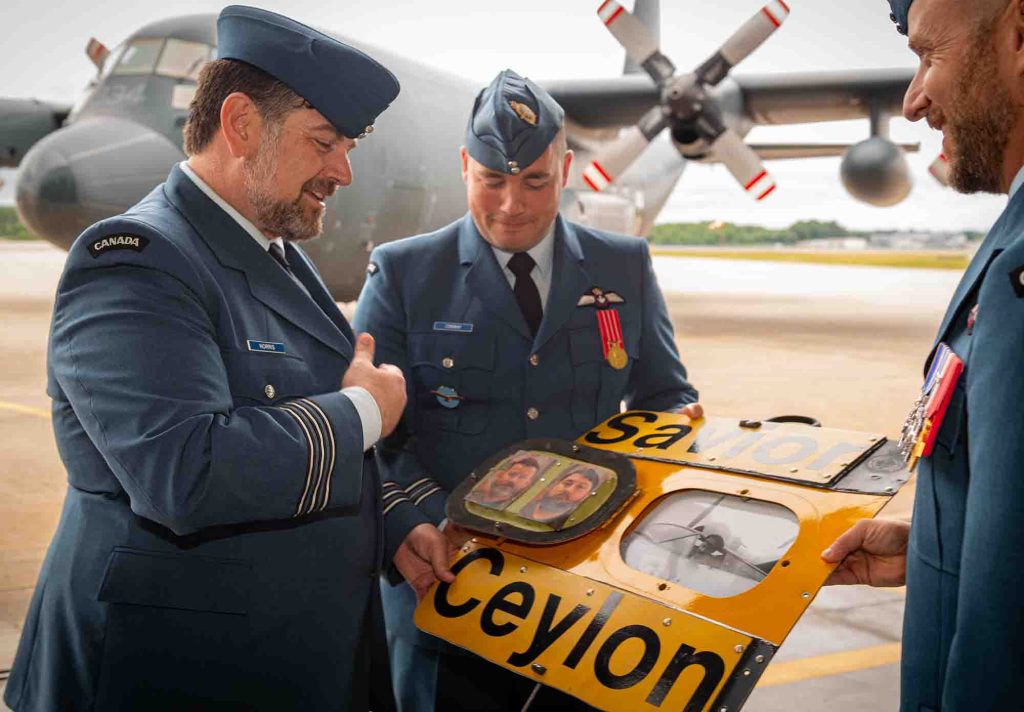
He highlighted the late, heroic 413 Squadron Air Commodore Leonard Birchall, “the savior of Ceylon;” and challenged Tuskers to remember Birchall’s service before self as some of the last few squadron members who met Birchall prepare to retire themselves. He reminded the audience of the squadron’s 1940s and ‘50s effort to map the Arctic, laying the groundwork for Canadian sovereignty in the North. 413 has flown over a dozen aircraft through the decades, perhaps the most of any Canadian unit, with more to come in the Kingsfisher and the rejuvenated Cormorant. Personally, he cited early and impactful mentors’ roles in “making me who I am.” He vividly remembers one of his first rescue flights, dropping supplies to a mother and her large family five days overdue on a Northern canoe trip. Being the CO in 2023 as 413 Squadron marked the 25th anniversary of the loss of CH113 Labrador 305 and its six crew, and attending the Beechwood cemetery interment of Captain Peter Musselman’s remains was an honour.
Norris also credited 14 Wing and its “Operate as One” motto: the ties between 413 Squadron and the long range patrol community are strong, and the support from partners around the wing for the challenging and unpredictable life of 413 Squadron and its members is deeply appreciated.
“Goodbye. Thank you, thank you, thank you.”
Boone, returning for his third tour with 413 Squadron, says his new role is a “dream come true.
“This is my family – I started here as a SAR pilot, and I’m hoping to be here to usher the Hercules out. I’m a Newfoundlander, so now I am closer to home, protecting ‘my people,’ and happy to be working with all of you. The Hercules, search and rescue – this was my first choice back in 2008 as an OJT; today means a lot to me.”
Norris leaves 14 Wing Greenwood for a year of language training, and then will post to Jakarta as the Canadian defence deputy attaché in Indonesia. Boone arrives in Greenwood from Ottawa, where he most recently worked as the chief of defence staff’s strategic engagements lead.