Several turtle species in Nova Scotia are at risk of extinction from threats associated with human activity. Turtles are crucial to our wetland ecosystems, helping control insects, snails and small fish; and maintaining a healthy balance of vegetation in freshwater habitats. Turtles need help from humans, as we continue to encroach on their habitat through urbanization and agricultural development. Road mortality is a real problem. Hatchlings are eaten by skunks and raccoons.
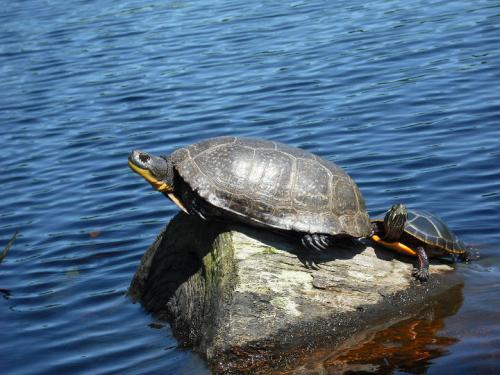
Blanding’s turtles are recognized by their smooth black or dark brown carapace (top shell), yellow chin and throat. Their plastron (bottom shell) is yellow, and an adult grows to about 28 centimetres in length. Nests are dug in late May to early June in high sun exposure in forest clearings, meadows or shorelines. In natural conditions, they can live around 80 years.
The Common Snapping Turtle is Nova Scotia’s largest freshwater turtle – up to 50 centimetres long. Its carapace is relatively flat, brown to black in colour. Its plastron is smaller than the carapace, making it difficult for the turtle to protect itself by retreating into its shell. They have large claws, muscular limbs and a long tail. The females nest from late May to early July and will travel several kilometres to find a good spot. They can reach 70-plus years old.
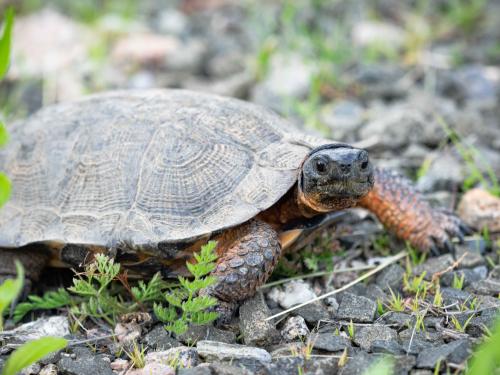
Wood Turtles have a woody-looking shell with varying colours of yellow, brown and black and measure from 17 to 22 centimetres. The yellowish plastron is flat on the females and concave on the males; both have a black head with orange flecking and the neck, legs and tail are brown on top and orange underneath. They like a slow-moving stream or deep pool, and a nesting spot that receives plenty of sunlight. They can live more than 50 years.
The Eastern Painted Turtle is Nova Scotia’s most colourful turtle, with red and yellow streaks on its neck and legs and a smooth shell. The plastron is a tan/ yellow and usually unmarked. These turtles prefer shallow, slow-moving water with lots of plants and plenty of basking areas. They grow to 13 to 17 centimetres. They like a high sun exposure: you may even see them digging a nest in late May or early June along the shoulder of a road. These painted turtles may live 50-plus years.
When turtle young emerge from nests, they can be hard to see – perhaps only 2.5 centimetres in length: they may easily be run over by a car if nests are near roadways. This is why you see road signs near the golf course here at 14 Wing Greenwood.
If you see a turtle in distress (maybe crossing a road) and you want to help it – if it is safe, there are some things to remember:
- If it’s a snapping turtle, watch your fingers! Try not to pick up the turtle anywhere near its head: they have a long neck and a very sharp beak and claws. Gently lift them onto a car mat, a towel or even a shirt; holding them as far to the back of the shell as possible. Drag them, gently, across the road. You may also carry them with one hand underneath and one on top. Carry any turtle as close to the ground as possible.
- Always move a turtle in the same direction it is travelling (even when you think there is a nice habitat behind them).
- Never pick a turtle up by its tail, as it could cause serious injury.
- Finally, wash your hands. Turtles may carry bacteria that isn’t harmful to them, but could be to humans.
Let’s help look after our protected turtle species so we have them for years to come! To report a turtle sighting at 14 Wing Greenwood, contact Melissa, Wing Environment technician, 902-765-1494 local 568-5007.
Nova Scotia Museum of Natural History

Nova Scotia Museum of Natural History

Nova Scotia Museum of Natural History
Nova Scotia Museum of Natural History