Visiting DFS leads looking for proactive effort to protect, preserve RCAF assets
Colonel Frank Gauvin and Chief Warrant Officer Sebastien Robichaud brought a message from the commander of the Royal Canadian Air Force, their own office team and peers across the RCAF to 14 Wing Greenwood personnel on their semi-annual Directorate of Flight Safety briefings.
“Do your jobs.”
“We have policies, procedures, checklists – follow them,” Gauvin said. “A lot of the things we see are people not following what we should. Flight safety is an enabler. We have a limited number of airframes and resources and, if we break it, we don’t have it when we need it.”
Gauvin is the director of the Canadian Armed Forces’ flight safety program for the air force, navy and army; he’s also the air worthiness investigative authority. He and Robichaud regularly take the lessons learned in their office’s work to RCAF wings across the country.
“If you’re working on this wing, flight safety applies to you,” Gauvin said. “Distractions, baggage you bring with you to work, pressure, supervision, communicating procedures, experience…. All the little things, the unsafe acts, lead to an incident or fatality. We’re trying to nip those in the bud so we don’t get to that point.”
Robichaud highlighted how the RCAF training standard ensures every member is well-trained, regardless of experience – but “we try and go fast.
“We’re trained to do the job: do it properly, task your personnel appropriately, learn how to prioritize the priorities and let your people do the job,” Robichaud said. “Take your time; we’re all allowed to ask questions.”
Gauvin reviewed the flight safety’s formal recognition of confidentiality and privileged information, and legal protections; and the difference between a “just culture” of reporting and being held responsible. The DFS and air worthiness investigative offices have direct lines of communications to both the commander of the RCAF and the minister of national defence, respectively.
“We are reactionary a lot of the time, when there is an incident,” Gauvin said. “We’re working on pro-action: looking at past incidents to identify risk and hazards, analyzing trends and seeing what’s happening.”
Deputy Wing Commander Lieutenant-Colonel Dev Pacquette thanked Gauvin and Robichaud for their presentation, and the 14 Wing personnel for taking it in.
“The importance of flight safety can’t be overstated,” Pacquette said. “It’s so important everyone on the floor, everyone flying has that culture – that flight safety is not about blame, but about protecting people, and the next generation.
“You’ve all had that discussion: ‘Is this a flight safety?’ If you’re talking about it, put it in.”
Gauvin seconded that approach to flight safety: “if you’re not reporting it, we can’t track it or act on it. Report it.”
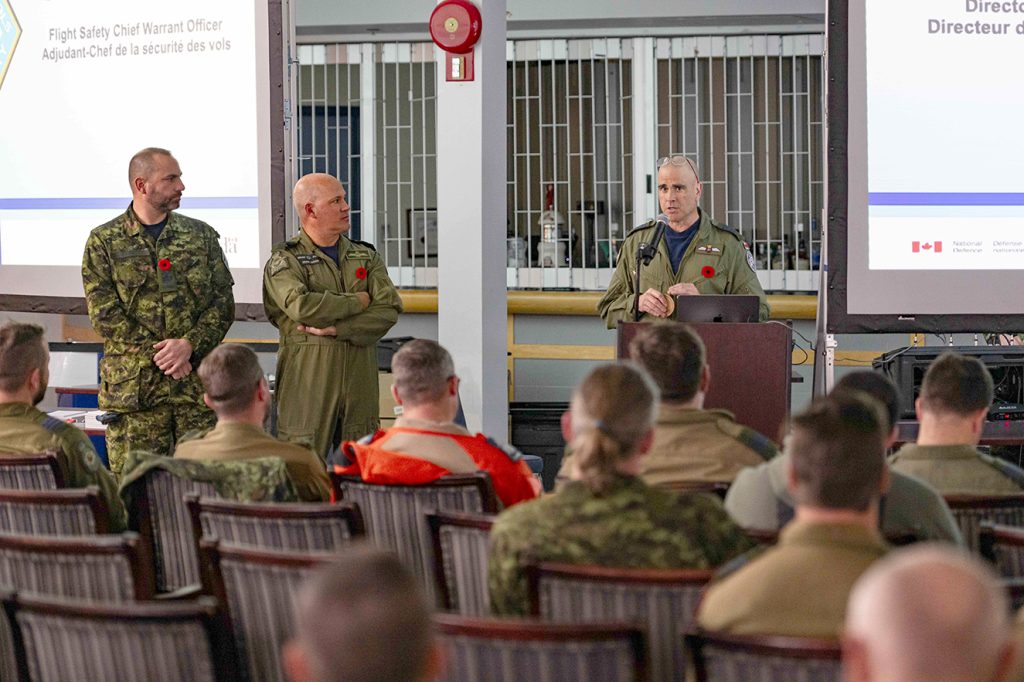
14 Wing Greenwood Commander Colonel Jeff Davis, right, was on hand October 30 to introduce the Director of Flight Safety, Colonel Frank Gauvin, and DFS Chief Warrant Officer Sebastien Robichaud, left, during the their visit of tours and presentations to 14 Wing personnel.