Presentation September 24 updates regiment’s ‘most prized and sacred possession’
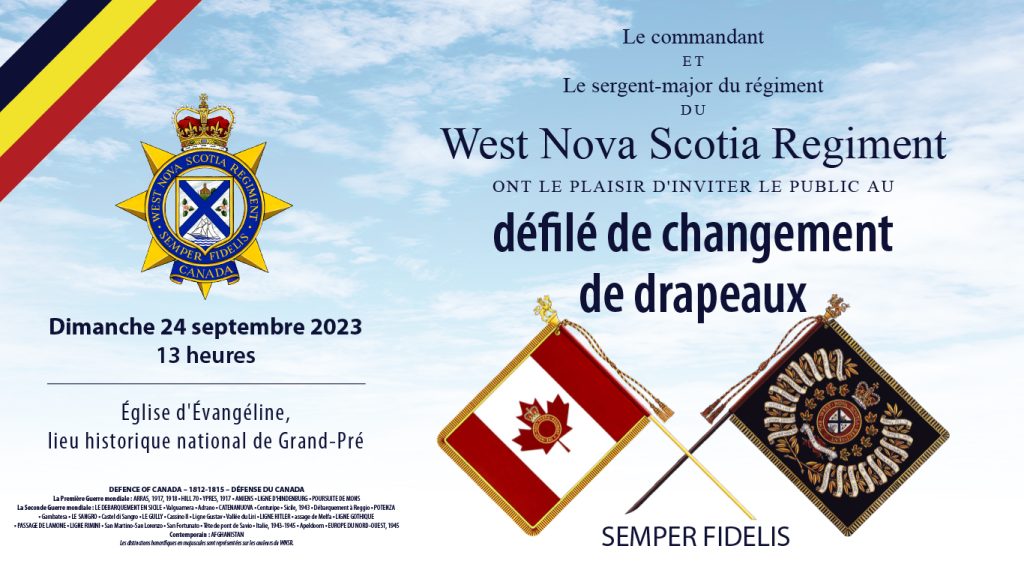
The West Nova Scotia Regiment marks a significant event Sunday, September 24, as it hosts a parade, presentation and consecration of its new King’s and Regimental Colours at the Church of Evangeline, Grand-Pré National Historic Site, at 1:30 p.m.
Regimental Colours are an organization’s most prized and sacred possession. They are normally presented personally by the Sovereign. Historically, Colours identified units and provided a rallying point in the line of battle. Today, they are no longer carried in action; they continue to be visible symbols of pride, honour and devotion to Sovereign and country.
WNSR Commanding Officer Lieutenant-Colonel Mike Bobbitt will march on the regiment at 1 p.m. (guests should be in place by then; the public is welcome to attend), followed by the arrival of the commanders of both 36 Canadian Brigade Group and 5th Canadian Division for the General Salute. His Honour The Honourable Arthur J. LeBlanc, ONS, KC; Lieutenant Governor of Nova Scotia, will arrive and receive the Royal Salute.
LeBlanc will inspect the regiment, before the current WNSR Colours are marched off. The regiment’s drums will be arranged, the new Colours placed on them for the consecration ceremony and the regiment will formally be presented its new King’s and regimental Colours. LeBlanc will address the parade, preside over the march past and advance in review order of the regiment, before he receives the Royal Salute and departs. The 5 Div and 36 CBG commanders will receive the General Salute and depart, followed by the march off of the Colours, falling out of officers and the WNSR regimental sergeant major march off of the regiment.
The receipt and consecration at Grand Pré holds special significance: the West Nova Scotia Regiment cap badge, which is worn by every member of the unit, bears the Church of Evangeline on it.
The parade also coincides with the 72nd September 23 and 24 weekend reunion of the West Nova Scotia Regimental Association. For more details on the association, visit wnsr.ca/ra.
WNSR Colours tell a story
The West Nova Scotia Regiment has earned 38 Battle Honours in its 306-year collective service by member units, dating to 1717.
The first is an acknowledgement of the role played by WNSR forefathers in the War of 1812. They came from six Militia units: 1st and 2nd battalions of the East Annapolis Regiment, the West Annapolis Regiment, and the Kings County Regiment.
The Colours include six battle honours from the First World War, awarded to the Annapolis and Lunenburg regiments after the First World War.
Second World War contributions by the West Nova Scotia Regiment led to 26 battle honours, of which 10 would be emblazoned on the new regimental Colours presented to the regiment in June 1959 in Annapolis Royal on behalf of her Majesty Queen Elizabeth II by then-Lieutenant Governor Major-General the Honourable EC Plow, CBE, DSO, CD.
The WNSR has since been granted two more battle honours, which will appear on these new Colours, making 18. The second is for the service of WNSR soldiers in Afghanistan.
The 1959 Queen’s Colour had the Union Jack as a background; the 2023 King’s Colour has a Canadian flag as its background. The background of the regimental Colour remains the same, but this is where the additional battle honours are emblazoned.
The Colours have changed to reflect the history of the regiment as it stands at this moment in time. They will be presented on behalf of His Majesty King Charles III by Nova Scotia’s current Lieutenant Governor the Honourable Arthur LeBlanc, ONS, KC.
Battle Honours (38)
(Honours in full capitals are depicted on the WNSR Colours)
- DEFENCE OF CANADA – 1812-1815 – DÉFENSE DU CANADA
- The First World War (6) – ARRAS 1917, 1918; HILL 70, YPRES 1917, AMIENS, HINDENBURG LINE, PURSUIT TO MONS
- The Second World War (26) – LANDING IN SICILY, Valguarnera, Adrano, CATENANUOVA, Centuripe, Sicily 1943, Landing at Reggio, POTENZA, Gambatesa, THE SANGRO, Castel di Sangro, THE GULLY, Cassino II, Gustav Line, Liri Valley, HITLER LINE, Melfa Crossing, GOTHIC LINE, LAMONE CROSSING, RIMINI LINE, San Martino-San Lorenzo, San Fortunato, Savio Bridgehead, Italy 1943-1945, Apeldoorn, NORTH-WEST EUROPE 1945
- Contemporary – AFGHANISTAN

With 1717 roots, WNSR has strong, Canadian heritage
The West Nova Scotia Regiment is one of the oldest Army Reserve regiments in Canada, formed in 1936 from both the 69th Annapolis Regiment (1717), and the 75th Lunenburg Regiment (1870). Both regiments descended from the 40th Regiment of Foot, the Prince of Wales Volunteers, raised August 23, 1717, at Fort Anne, Annapolis Royal. The WNSR also perpetuates the 112th and 219th Battalions of Infantry, Canadian Expeditionary Force, formed in the First World War.
When the Second World War broke out, the WNSR mobilized September 1, 1939. A second battalion was recruited for home defense. At least 1,600 men tried to enlist. The active service battalion left from Halifax, disembarked at Gourock, Scotland, and immediately entrained for Aldershot, England, just after Christmas 1939.
June 15, 1943, the regiment embarked from Gourock in the first part of “Operation Husky,” the invasion of Sicily, landing July 10. July 17, while moving forward to flank a position the Carleton and York Regiment were attacking, the WNSR came under German mortar fire. They dug in and held out, despite German demands for surrender. The advance continued, and the regiment fought in Adrano, Catenanuova and Centripe.
Next came the invasion of the Italian mainland, as the Allies crossed the straits of Messina. September 3, A Company landed at Fox Amber, the first Allied soldiers to invade the continent of Europe. A combined arms battle group formed, with the WNSR providing the core. In 60 hours, the force advanced 75 miles from Villapiana to Potenza, where the Germans made a serious stand: they were denied by the rapid, Canadian “dash and daring” advance.
Other important battles the regiment fought in Italy were the Gully (on the approach to Ortona) and the breaking of the Hitler Line. February 9, 1945, the WNSR, with the 1st Canadian Corps, was transferred to Northwest Europe, moving to Marseilles by sea and arriving in Germany April 4. April 13, it was committed to a breakout of a bridgehead on the Ijssel River in Holland. The regiment continued into Holland until the German surrender, effective 8 a.m. May 5, 1945.
The regiment stayed in Holland for four months and then left for Canada from Portsmouth September 24, 1945. It arrived in Canada October 1. There are 352 Second World War WNSR soldiers’ graves from Sicily to Holland. Added to this were 1,084 wounded and missing.
The WNSR remains an active Canadian Army Reserve unit, with soldiers serving in the former Yugoslavia, Cyprus, the Middle East and, more recently, in Afghanistan and Eastern Europe. Soldiers continue to participate in unit training both in Aldershot, Nova Scotia, and Gagetown, New Brunswick, and around the world.
For information on the WNSR, visit wnsr.ca.