Air Reserve working to meet people, work, change
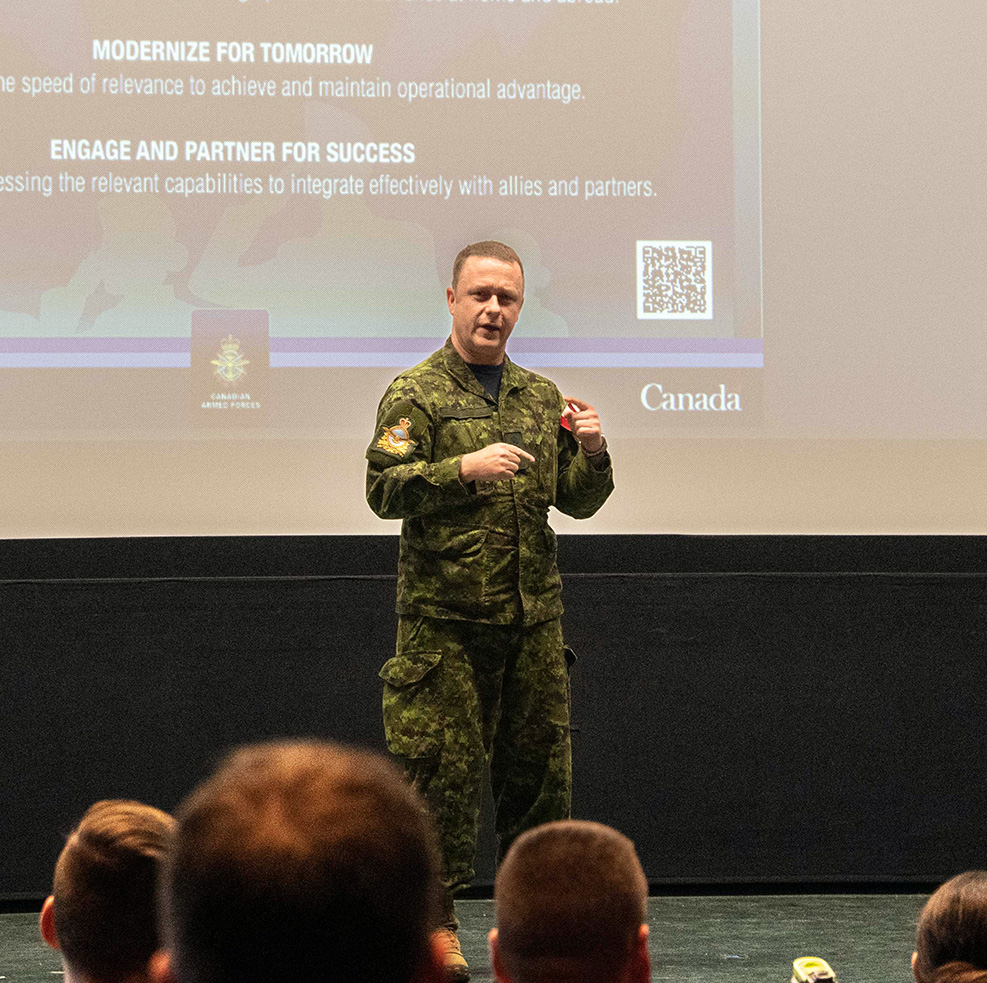
A June 14 town hall session with 14 Wing Greenwood’s Air Reserve members was an opportunity for the national leadership to recognize their work, but also to address their questions and concerns.
“Thank you for coming – seeing your work on tours around 14 Wing this morning was outstanding,” said Director General Air Strategic Resources and Air Reserve Brigadier-General Justin Thibert. “This is my first time in Greenwood, visiting people on the ground, doing their work for the air force.”
He was echoed by Air Reserve Chief Warrant Officer Jim McKenzie, who did spend time in the early years of his career posted in Greenwood.
“You do outstanding work,” McKenzie said. “We hear it from everyone we go see, the flight commanders and commanding officers: they know what they need to do would fail without you.”
14 Wing Air Reserve Flight Commander Major Fred Stanley introduced the men on the town hall stage and encouraged flight members to ask questions.
“This is the top of the Air Reserve chain: hit ‘em up, see what the top says!”
Thibert agreed to the challenge, getting set to provide opening remarks about the state of the Air Reserve.
“We have a lot of ideas – but not all of them. By all means, share them with us.”
Thibert opened acknowledging the challenges facing both the Canadian Armed Forces as a whole, and the Air Reserve.
“Our strategic intake was about 40 per cent last year, and we need more to sustain the needs across the CAF,” Thibert said. “It’s quite alarming, and we’re also struggling with attrition – our organization was shrinking.”
Pandemic effects on recruitment and adding time to the processing of potential members only exacerbated problems that have been growing for a number of years.
“Without the people, we don’t have the ability to deliver air power – for the capabilities we have, and the capabilities that are coming.”
The positives are on the horizon, as the CAF undertakes the largest modernization of its mission since the Second World War, NORAD modernizes, the F35 initiative advances and more change lies ahead.
“People power? We’re really going to have to press hard to meet those requirements,” Thibert said.
He and McKenzie have spent the last 18 months focused on attraction, recruitment and retention changes, from figuring out better ways and places to meet people potentially interested in the Air Reserve, to “file-following” recruits through applications and acceptance all the way to experienced members looking for service extensions beyond age 60.
“We’re working on taking better care of our people: the application of Class C employment, and locations that qualify; capability-based recruiting, delegating authorities to move at a faster pace.”
McKenzie said there has been change in recent years, “but I don’t think we’re changing fast enough. Of 2,000 Air reserve members, 900 are over age 50. Reservists are doing tremendous work; we’re working on recruiting and retaining – but Reservists and component transfers have to know they’re coming to a place where we do enough.”
Thibert and McKenzie have several proposals in front of leadership now they hope to have accepted – by the end of this month, or in the near future. They have more proposals waiting in the wings, intending to take initial “wins” as examples of what good change looks like, and how more can be actioned. Some of these files, and next steps, may help address town hall-raised issues such as FORCE testing recruits before enrolment, separate CAF and Air Reserve pay systems, localized CAF entry testing, skilled trade equivalency for new recruits, Class C pay delays, medical care for Reservists in roles that require medical standards – or all Reservists.
Travelling with Thibert and McKenzie were Colonel Maryse Simard, Lieutenant-Colonel Sarah Thornton, Captain Jeffrey Arnold and the incoming Air Reserve chief warrant officer, Chief Warrant Officer Sean MacEachern.
MacEachern, wrapping up a term as Air Reserve career manager, and with a few moments to greet Reservists; encouraged them to think about all Thibert and McKenzie’s efforts, and also “be our own advocates.
“Sell the CAF to people who may be thinking of joining; then, treat new members and each other well so people stay,” MacEachern said. “Trust us that we’ve heard you, that we’re working hard to get you what you need to work. We have to get better: people can’t wait for us. They won’t.”