June 25, 1943, five light Ventura Mk II bombers left the British Commonwealth Air Training Plan aerodrome at Pennfield Ridge, New Brunswick, on a low-flying cross-country navigation exercise. The Lockheed Ventura was a Second World War-era twin-engine medium bomber and patrol bomber.
While two Venturas were flying over the Avon River in the Falmouth, Windsor and Summerville area of Hants County, Nova Scotia, one of the planes – AJ186 – developed engine trouble. When one engine malfunctioned, then failed; and the other either shut off or failed, this plane turned inland towards Stanley. However, it quickly lost altitude, struck a large pine tree, somersaulted and crashed near Musgrove Road, Summerville. All four airmen aboard perished in the crash.
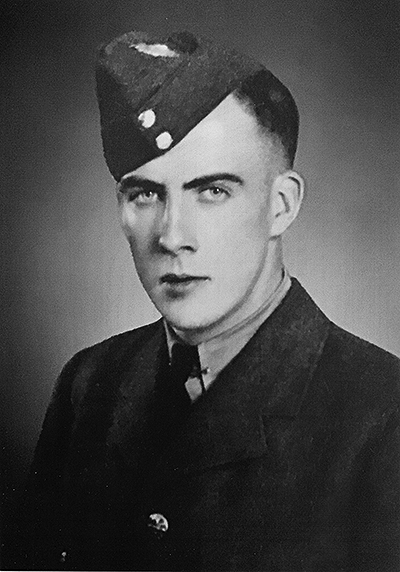
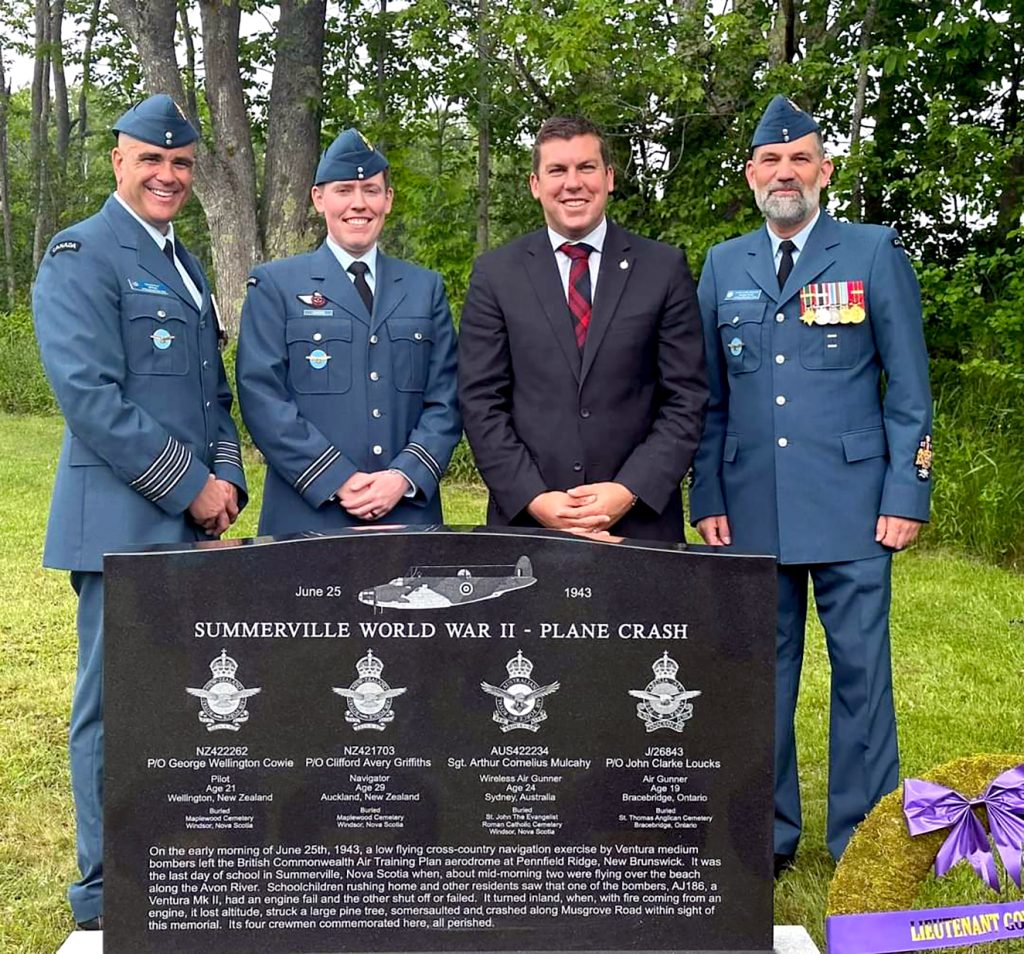
The four airmen were Pilot Officer George Wellington Cowie, 22, pilot, Wellington, New Zealand; Pilot Officer Clifford Avery Griffiths, 29, navigator, Auckland, New Zealand; Pilot Officer John Clarke Loucks, 19, air gunner, Bracebridge, Ontario; and Sergeant Arthur Cornelius Mulcahy, 24, wireless air gunner, Sydney, Australia.
It was about mid-morning on the last day of school when the crash occurred. It was witnessed by a number of students on their way home as well as other residents of Summerville.
The two New Zealanders are buried side by side in Maplewood Cemetery, Windsor, and the Australian in St. John the Evangelist Roman Catholic Cemetery, Windsor. The Canadian is buried in his hometown of Bracebridge, Ontario.
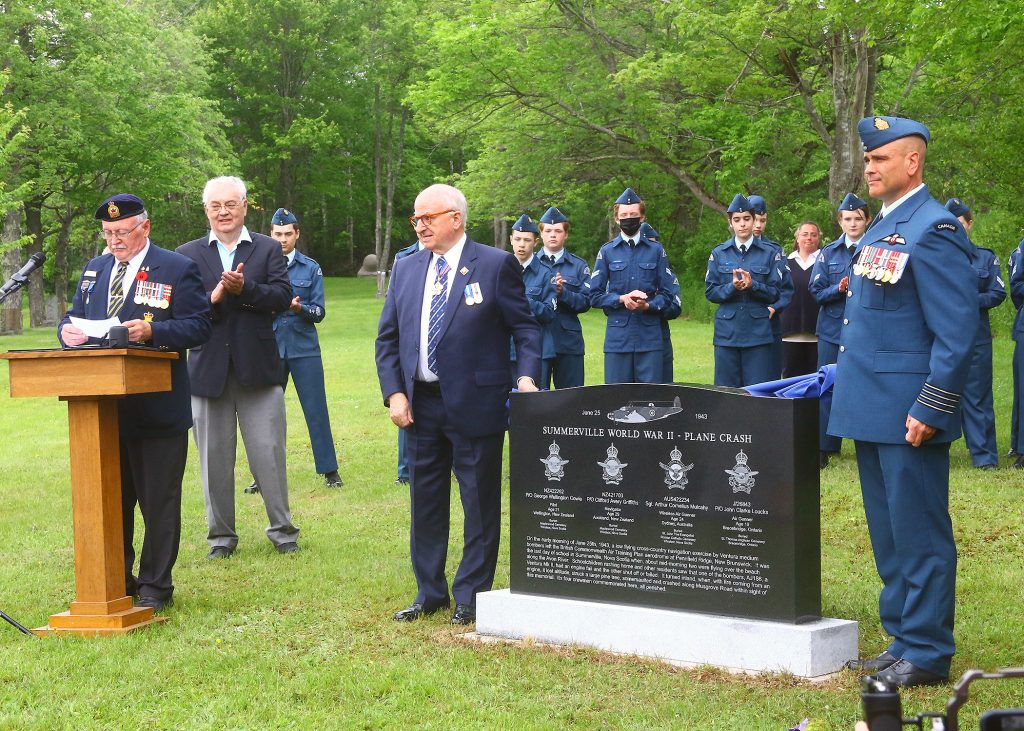
Although each grave of the fallen airmen is marked, there has never been anything to commemorate this tragedy. The West Hants Historical Society took it upon itself to arrange for a suitable memorial to be placed in the Musgrove Road Cemetery, Summerville, within sight of the crash site. The black granite memorial is approximately four feet in length, and was provided through the generous donation of Heritage Memorials Limited, Windsor. With the valuable assistance of Royal Canadian Legion Branch 9 and Summerville & District Volunteer Fire Department, an unveiling and dedication ceremony was held June 25 – marking the 80th anniversary of the crash.
The ceremony included the national anthems of Canada, Australia and New Zealand, and a welcome from Gary Nelson, vice-president of the historical society. A number of wreaths were laid, including one by Susan Nelson from New Zealand and crash eyewitness Doris Dodge, in honour of Cowie; Amelia Branson from New Zealand in honour of Griffiths, and members of the Loucks family. The Pennfield Parish Military Historical Society, New Brunswick, also presented a wreath.
Royal Canadian Air Force Captain Grace Loucks, whose grandfather was a first cousin to Loucks, has worked as a tower controller at 14 Wing Greenwood for the past two years. She and several members of her extended family attended the June 25 dedication: some she knew, and some she’d never met.
“I didn’t join the air force knowing he was part of our history – I didn’t really even know him, but it was my Dad’s ‘genealogy journey’ where we first really heard about this 19-year-old who died in a horrific crash, on just his second flight out,” Captain Loucks says. “I joined because I talked with a second cousin –he’s a pilot in Cold Lake, still in. My grandfather served in the Second World War, and my grandmother was a volunteer nurse.”
Having what appears to be a deeper connection to service within her family uncovered – and remembered – made for a good day.
“The West Hants Historical Society is a really passionate group of people who volunteer to keep track of the history of their community.”
14 Wing Greenwood Commander Colonel Jeff Davis agrees, as he and Wing Chief Warrant Officer Jonathan Proulx’s attended the dedication event.
“We really just expressed our thanks to the community,” said Davis. “We went back and visited afterwards at the fire hall, and thanked the West Hants Historical Society volunteers, the community and the Legion members. It’s incredible to have been there with people who experienced the crash, and with family whose relatives were involved. The memorial event was an important display of what happened in their community and the impact it had.”
J. Ivey