Hercules recognized, remembered, roasted at 14 Wing farewell event
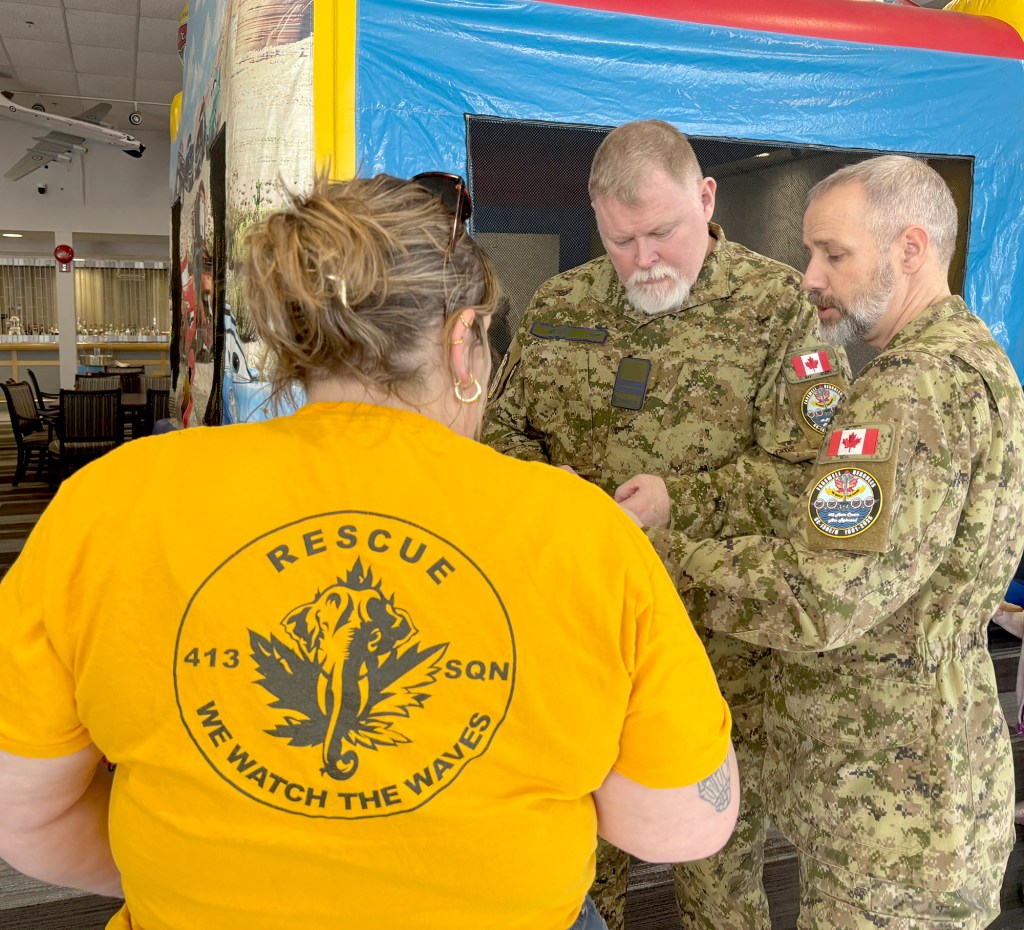
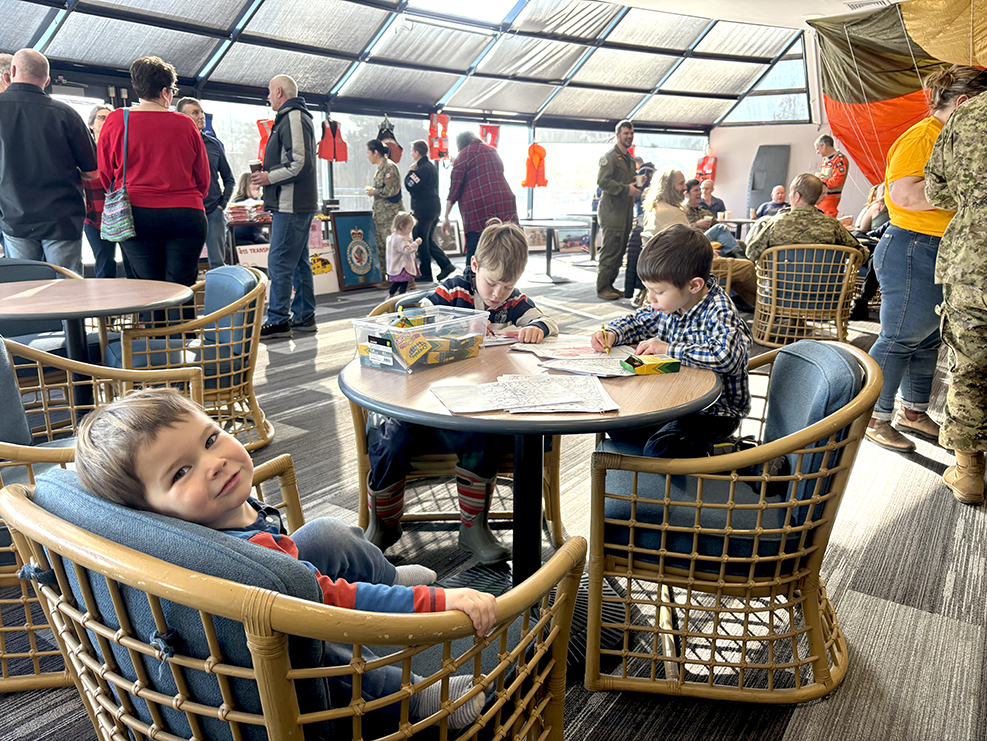
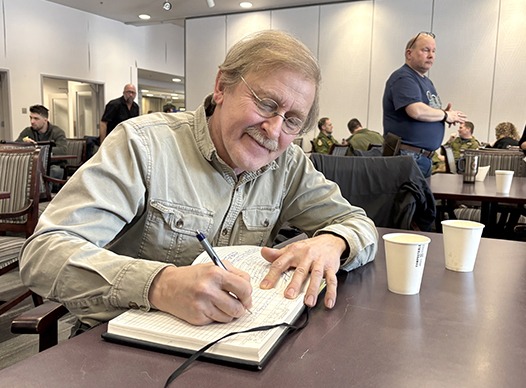
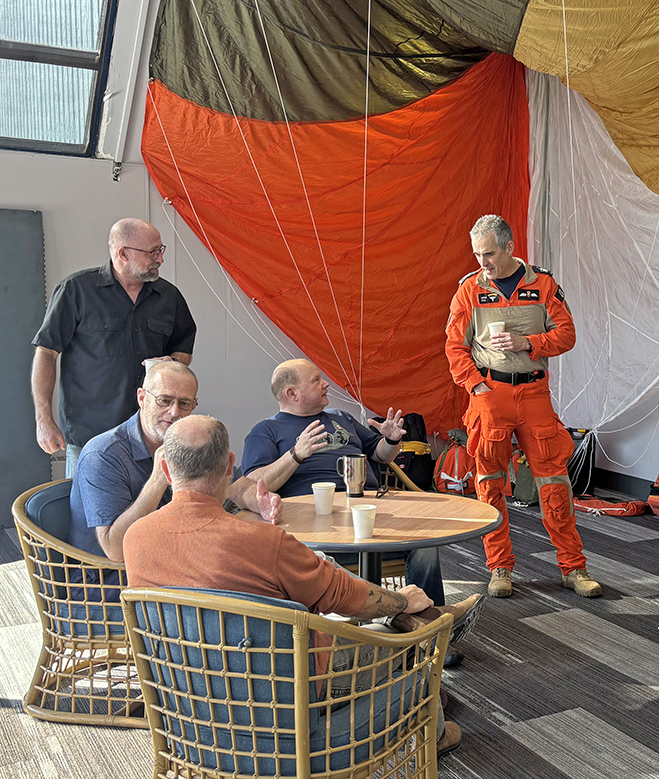
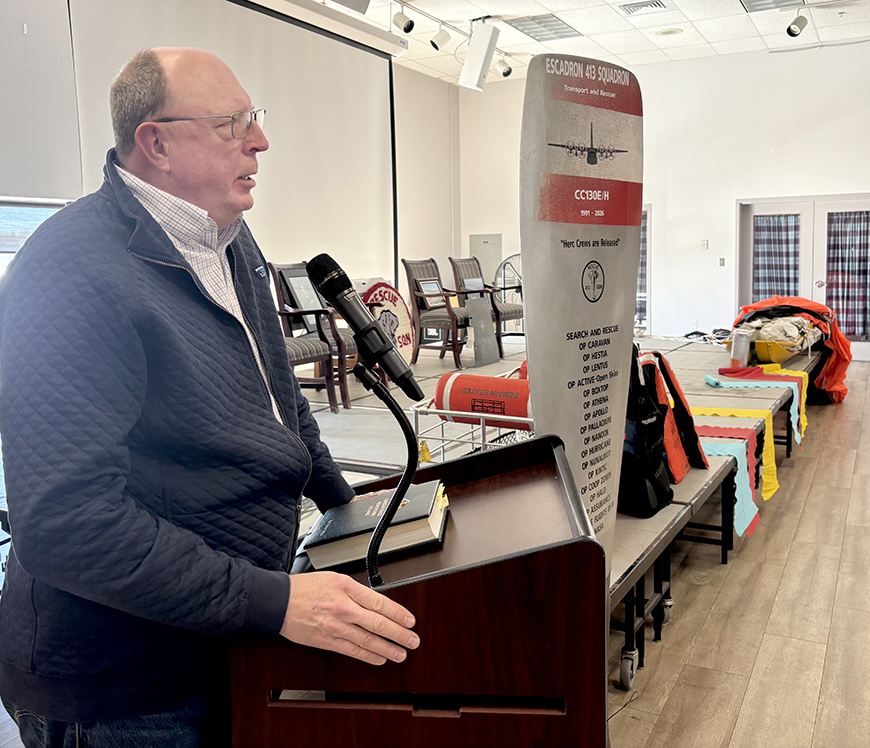
While the guest of honour didn’t make it, the personality, steadfastness and legacy of the Royal Canadian Air Force CC130 Hercules was close to everyone’s heart at a February 13 Herc Farewell event, hosted by 413 (Transport and Rescue) Squadron at 14 Wing Greenwood.
Emcee Captain Dave Pearson read comments as if prepared by the Hercules, speaking on its behalf and summarizing its 35-year contribution to strategic lift, Northern operations, and search and rescue from 1991 to January 2026.
“I wasn’t sleek. I wasn’t modern. Maybe slightly leaking. Yes, there were prop seal failures. No heat in the winter. No AC in the summer. Every preflight was an adventure: you didn’t inspect me; you ‘discovered me.’ When the call came in the middle of the night, you didn’t ask if I was comfortable. You asked if I was ready.
“I showed up.”
Pearson asked for allowances through his own remarks for perhaps becoming emotional, as he ends his own first operational tour with the Herc’s retirement, and will soon be posted from 413 Squadron.
“Today is about more than an aircraft – it’s about people.”
Herc, in its comments through Pearson, agreed.
“Oh, my maintainers. You didn’t just fix me, you resurrected me…; I liked you best: you understood me. The aircrew flew me; you kept me alive.”
As the Hercules flight engineer and loadmaster trades disappear, too, Herc called the FEs “system whisperers.
“You didn’t need a computer to tell you what was wrong: you listened, you felt vibrations through the airframe… you translated my ‘moods.’ You bought time; you saved missions.
“And, my loadmasters: the calm at the back, the masters of weight, balance and controlled chaos….”
Herc also had words for the pilots, the air combat systems officers and the search and rescue technicians, all making the transition to “your shiny new CC295; your two-propped ‘flying banana,’” with its state-of-the-art computers, sensors, alerts and software.
“It will never know what it’s like to have a crew that truly knows their aircraft: maintainers who refuse to let it quit, the pride of a loadmaster in the back in terrible weather, steady and unshaken; the sound of 413 owning the sky in something load, stubborn – and unforgettable.”
Hercules legacy launches future SAR service
413 (Transport and Rescue) Squadron Deputy Commanding Officer Major Kristopher Kelusky acknowledged “it is very difficult to honour our past, and still charge ahead into our future, but it is important.
“This represents a change in our capability, our crew and our culture; new equipment, new challenges, new personalities and new relationships.
“Relationships between people and machines – we personalize those, and we are thankful to have had the Hercules as a versatile, robust – truly – an awesome aircraft to fly. We never doubted it would get us home. Job well done.”
Deep Herc connections through decades of service
Warrant Officer (retired) Regent Patoine, a flight engineer aboard the CC130 Hercules, recounted three tragedies deeply tied to the Hercules’ work while he was at 413 (Transport and Rescue) Squadron, from 1996 to 2000. He was part of the 413 crew that flew to Guyana to airlift a Hercules crew involved in a July 1, 1998 road accident: one died, and several were severely injured. He was on the first Herc flight in the air following the September 2, 1998 crash of Swissair Flight 111 off Nova Scotia, heading first to Gander to pick up additional military search crews, delivering them to a sea of orange at the Shearwater search staging area. He was on the Herc that returned six squadron members killed in the October 2, 1998 crash of Labrador 305 in Marsoui, Quebec; arriving in Greenwood with hundreds of family, military and community members gathered in loss.
“Those were hard on the squadron; but, I’ve seen a lot of good things – a lot. A worldwide tour on the stretch Herc. I flew with Vice Admiral Leonard Birchall. I flew a lot of Boxtops. Flying rescues… we were way up North looking for a family and we saw a flash. ‘What was that?’ It was a big piece of aluminum foil they had, they’d unfolded and were flashing around.”
Patoine has an eight-millimeter film of his father, Jean-Guy, himself a military instrument electrical technician; walking off the RCAF’s first Hercules following training in Georgia, with himself as a kid running towards his father.
“That film – I realized later, I flew on that exact plane. He saw me as a flight engineer on other planes, but never the Hercules. He’d died before that.”
Loadmaster life full of memories
Master Corporal (retired) Murray Downing, a traffic technician by trade, spent “pretty much 40 years” around the Hercules as a loadmaster.
“There’s so much…,” he said, thinking through his memories.
“I first got in in ’82, and we were still loading Hercs in Shearwater – the E model, with the old colour scheme and the lightning bolt. I remember having the independence as the loadmaster to fly, loading everything safely, quickly and in austere conditions. I remember the SAR-Techs jumping into that s**t and thinking, ‘That’s going to suck.’ Black humour. I remember landing on a runway once, and seeing it move past the window sideways – definitely some ‘spicy’ landings.”
Hercules experience a career privilege
Major (retired) David Bolton still refers to the Herc as “my girl.” With 4,875 Hercules flying hours, he spent from 1997 to 2013 at 413 Squadron, and also had the “real privilege” through his career to fly all of the E, H, H73, H74, H90 and current model CC130s.
“Ugly, big; we never flew in any kind of luxury: we pooped in a can and peed in a hole; it was 85 decibels in the pilots’ seats and louder everywhere else…. A lot of missions were crazy or sad: my most happiest and most depressing moments were sitting on a Herc.
“Love those aircraft.
“Now, it’s riding off into the sunset – probably should have done that 20 years ago. Thank you.”
‘Big brother’ of SAR service
413 (Transport and Rescue) Squadron Chief Warrant Officer Bryce Culver, a search and rescue technician by trade, called the CC130 a “workhorse” through its decades of service.
“I started in rotary in Gander, and the Herc was a ‘big brother’ – the first on the scene, checking the weather, dropping flares so we could do our job. Then I flew fixed wing, and quickly learned the Hercs’ capabilities: anything on it, anywhere in Canada, any kind of weather – and got us home safely.
“We all know that.”
Culver thanked everyone for attending the Herc Farewell event, but acknowledged the absence of many 413 Squadron members: “SAR goes on.”