Transport Canada’s airspace regulations apply to you, too
Drones and lasers have recurring impacts on 14 Wing Greenwood airfield operations and flight crews: the most recent incident in November, a festive ground display of typical laser lighting projecting pretty images on the front of a Kingston-area home caught the eyes of a 14 Wing CP140 Aurora aircrew coming in for a landing.
“Pointing up, it’s the spill of that effect that misses the front of your home – that’s the concern,” says Warrant Officer Allan Upshall, 14 Wing Greenwood’s Deputy Wing Flight Safety Officer.
“Everyone’s front lawn is unique so there is no one installation angle that will work for all,, just aim for the front of your home and don’t create a hazard to aviation safety. It doesn’t mean you can’t have them, but be careful where you aim those lights.”
November’s laser holiday lights incident is another cautionary reminder to 14 Wing’s neighbours to pay attention to what they put into the air – and regulated airspace.
“Imagine you’re on the highway and someone approaches with their high beams on,” says Upshall. “You look away, but it makes it harder to see what is ahead and stay on the road.”
“Higher power lasers can cause physical injury to pilots’ eyes – burns. They have to lower their heads or look away. That could mean a loss of visuals near the airport, say, during take-off or landing, and the distraction – that hard transition to instruments only when you’re not expecting it, could add extra risk at a critical time.”
14 Wing often sees an increase in flight safety issues around the holidays, particularly with gifted drones taking to the skies. Multiple and complex Canadian Aviation Regulations (CARs) may be in play, depending on drone weight and where they are flown. A drone recently landed on the roof of the wing’s health clinic and had to be retrieved by Military Police when it broke (the owner called the wing and asked for it back). Flying a drone at Kingston’s Stronach Park duck pond is directly in 14 Wing’s airfield approach path.
“It all generates a flight safety occurrence: we investigate all of them with the goal of making aviation safer for everyone, which means providing information, an awareness campaign, working with the operator of a drone – if we can find them.”
Upshall says there has been nothing – so far – in drone or lights activity around 14 Wing or reported by 14 Wing aircrews that has caused the base to stop operations or cancel missions.
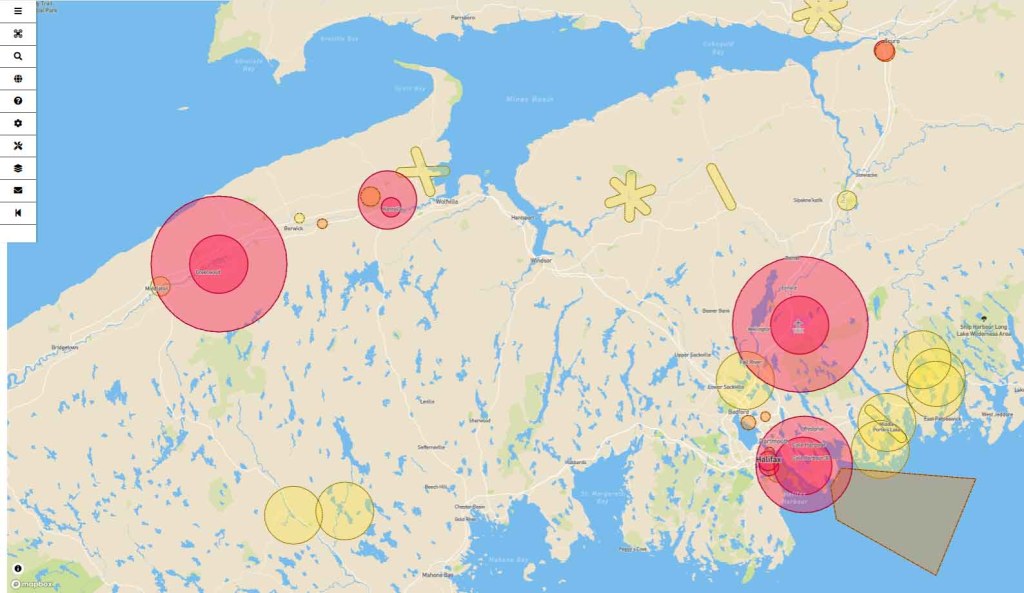
“Anytime you’re around where aircraft are flying low, you have to be really careful,” he says, even if the activity is allowed. In the Annapolis Valley, 14 Wing Greenwood’s airspace is covered by certain restrictions that people may more obviously think to check, but there are also other areas – even more restrictive than around 14 Wing – over 5th Canadian Division Support Base Gagetown Detachment Aldershot and a smaller area northeast of Berwick.
“Ignorance of the law is no excuse, but the law is complicated” Upshall says. “This is the law we follow – we here at 14 Wing, we in Canada – everyone in aviation follows the CARs.
“If uncrewed aerial vehicles (UAVs) or drones are Christmas presents, people need to know to go into the store informed, and then know how and where to enjoy them responsibly.”
Upshall says safety is behind 14 Wing Greenwood’s efforts to raise drone and bright light awareness – for aircraft, and for aircrew; and for the wider community should a drone or bright light cause a more dramatic incident.
“We want to reach out to the people who don’t know, and honestly wouldn’t do it if they did know. People who don’t know the rules could put us all in danger, even themselves and their families.”


Transport Canada site best starting – regular – resource
Please regularly check Transport Canada ( https://tc.canada.ca/en/corporate-services/acts-regulations/list-regulations/canadian-aviation-regulations-sor-96-433 ) for Canadian Aviation Regulations guidance – and updates (the most recent happened November 4). Transport Canada’s site is “more user-friendly, and has the best starting resources,” Upshall says. Top of mind for 14 Wing Greenwood’s neighbours are:
Hand-held Lasers
601.19 (1) No person shall have in their possession a hand-held laser with a power output rating greater than 1 milliwatt (mW) and
(b) within a 10-km radius of the geometric centre of an airport or heliport.
Projection of Directed Bright Light Source at an Aircraft
601.20 Subject to section 601.21, no person shall project or cause to be projected a directed bright light source into navigable airspace in such a manner as to create a hazard to aviation safety or cause damage to an aircraft or injury to persons on board the aircraft.
Those Kingston holiday decorations were not specifically hand-held lasers, likely mounted on stakes on someone’s lawn, and likely lower than that 1 mW power output rating; but they could be interpreted as a directed bright light source: “any directed light source (coherent or non-coherent), including lasers, that may create a hazard to aviation safety or cause damage to an aircraft or injury to persons on board the aircraft” – CARs, Division II – Aircraft Operating Restrictions and Hazards to Aviation Safety, 601.14.
A good primer for flying your drone safely and legally – what you fly, how you fly, where you fly and who will fly; microdrones, drone certifications and registration, insurance and privacy, and penalties may be found here: https://tc.canada.ca/en/aviation/drone-safety/learn-rules-you-fly-your-drone/flying-your-drone-safely-legally
Check your local area’s airspace restrictions here: https://nrc.canada.ca/en/drone-tool-2/