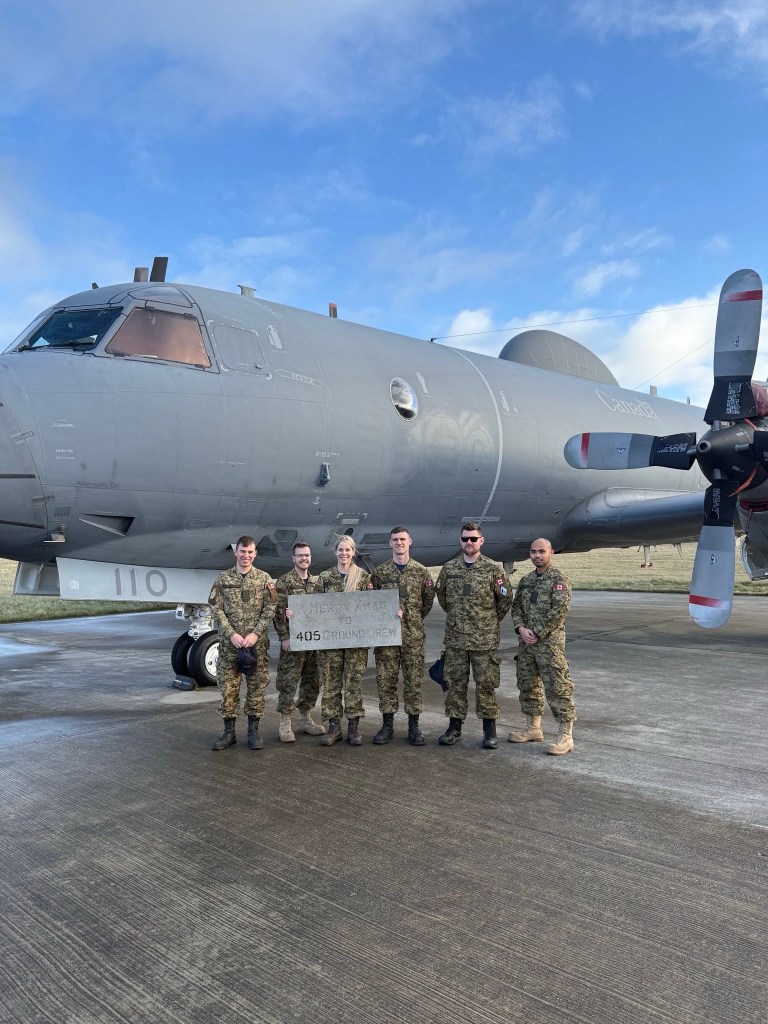
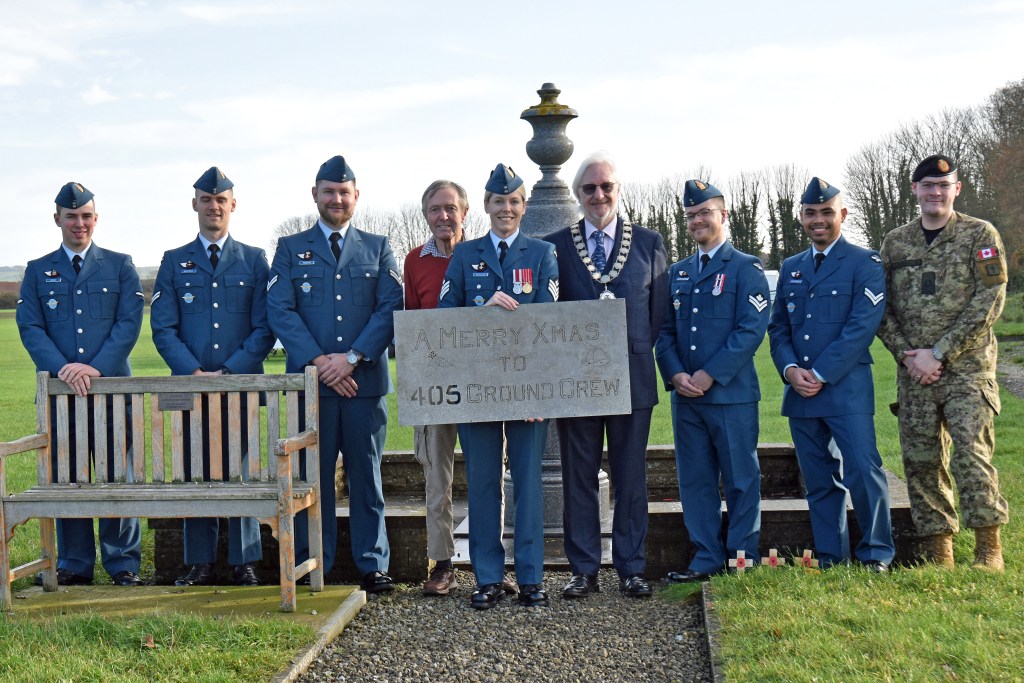
Members of 405 (Long Range Patrol) Squadron marked a meaningful connection to their past earlier in December, when a crew travelled to the United Kingdom to retrieve a Second World War artifact linked to the squadron’s earliest days. The mission, conducted December 7 to 10, also provided an opportunity to advance ongoing force-generation training for LRP aircrew and aircraft technicians.
The artifact, a metal panel stamped with the message, “A Merry XMAS to 405 Ground Crew,” was gifted to 405 Squadron aircraft technicians at Christmastime in 1941, while the squadron was stationed at RAF Pocklington. The piece was recently discovered in a private collection in the UK, offered back to 405 Squadron for preservation.
For the members of 405 Squadron, bringing the artifact home was far more than a courier task.
“It’s a rare and tangible piece of our heritage,” says Lieutenant-Colonel Joel Stubbert, commanding officer of 405 Squadron. “Our squadron was born in the United Kingdom in 1941, and the aircraft technicians who served then were essential to every mission launched against a determined adversary. As the world grows more complex and uncertain, relics like this sign serve as reminders to our young technicians and aviators that, even in the darkest moments of war, people still made the effort to show care and appreciation. Preserving it within the squadron will help keep them connected to a past defined by great sacrifice and enduring humanity.”
405 Squadron formed at Driffield, Yorkshire, April 23, 1941; the first RCAF bomber squadron to stand up overseas. From the outset, its success relied heavily on its aircraft technicians, who worked long hours in harsh weather and wartime conditions to keep the squadron’s Wellington, Halifax and Lancaster bomber aircraft serviceable.
That legacy continues at 14 Wing Greenwood, where today’s aircraft technicians support CP140 Aurora operations at home and abroad.
“Our aircraft technicians remain the backbone of our capability,” says Stubbert. “They were indispensable in 1941, and they’re just as indispensable now in 2025. Whether we’re deployed overseas or responding to urgent operational taskings, our aircraft only fly because of their professionalism and dedication.”
The trip to the UK provided an ideal venue for meaningful force generation training.
“We were able to complete an LRP aircraft commander (AC) check ride on one of our upcoming pilots,” said Captain Simon Sirois-LeCain, AC for the mission. “This trip helped determine that this junior pilot could be an aircraft captain in the future and conduct missions around the world, without a more senior pilot on the aircraft.”
Crews completed transatlantic flight planning, maintenance coordination and operational procedures aligned with current LRP training requirements.
“Flying back to where 405 Squadron cut its teeth in battle is more than a journey. It’s a reminder of who we are,” says Stubbert. “Our predecessors faced unimaginable challenges with courage and compassion. Their example of resilience shapes our commitment and inspires us to serve with purpose and integrity.”
“The artifact will be preserved and displayed at 405 Squadron, entrusted to the squadron’s aircraft technicians. Most reminders of past glory focus on the exploits of aircrew. This one honours the aircraft technicians, the skilled hands that keep us flying. This small piece of metal reminds us that courage is not only found in the skies but also in the unwavering dedication of ground crews who labour under pressure in cold, rain, and darkness to keep aircraft in the fight. We are proud to bring it home, and I know they will protect it and keep it safe for the next 84 years.”