After a morning of squinted eyes, pricked fingers and self-doubt, a dozen people left a special workshop satisfied with their own, personal symbol of remembrance.
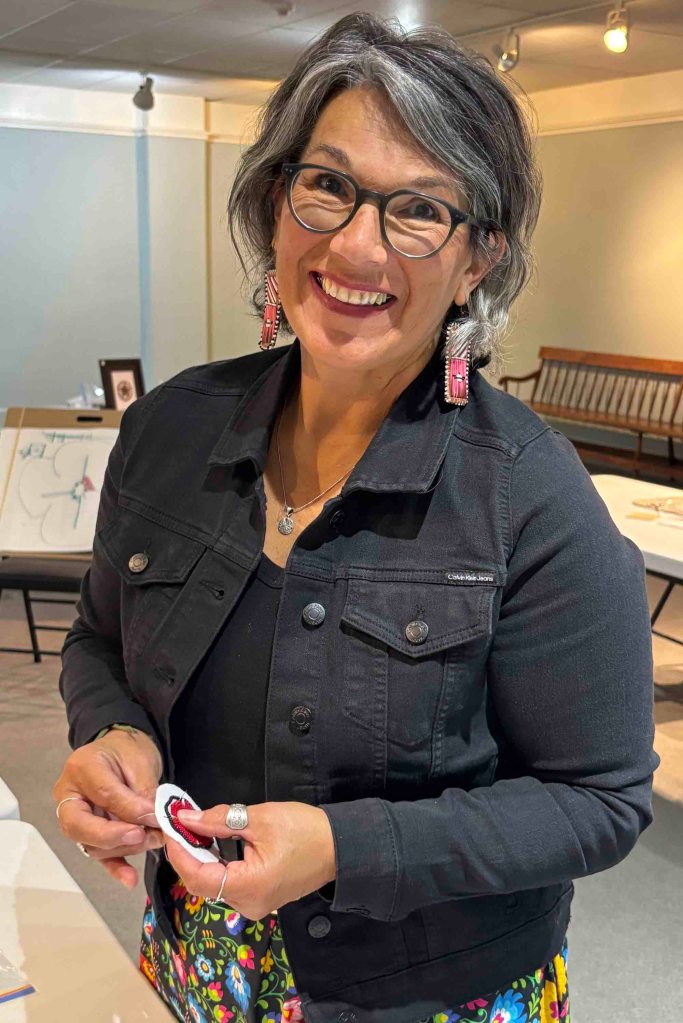
The Macdonald Museum in Middleton hosted Mi’kmaw artist Karen Beals October 16, as she shared a sampler of her traditional quillwork and beading in a pre-Remembrance Day beaded poppy project.
“Hello. Kwe’,” Beals said, sharing information on known Indigenous military service: it’s estimated 4,000 Status Canadian Indigenous soldiers served in the First World War, between 1914 and 1918; but it is likely higher as people did not self-identify as Indigenous. Many thousands more have since served – and continue to serve – in the Canadian Armed Forces.
“The beaded poppy has evolved to become a symbol, a sign of respect for Native veterans, their heritage and remembrance,” Beals said, describing how it was approved this Spring for wear within official CAF dress regulations.
“I maybe made my first beaded poppy 20 years ago.”
Beals, a Sixties Scoop survivor, is a member of the Glooscap (Pesikitk) First Nation. She came into her First Nations culture later in life, “putting herself out there” to connect with elders who shared their traditional skills to help her create her own quillwork, beading and birchbark art.
“I am always learning, every time I meet people, hear stories, do a workshop…. It’s all getting to know my culture.”
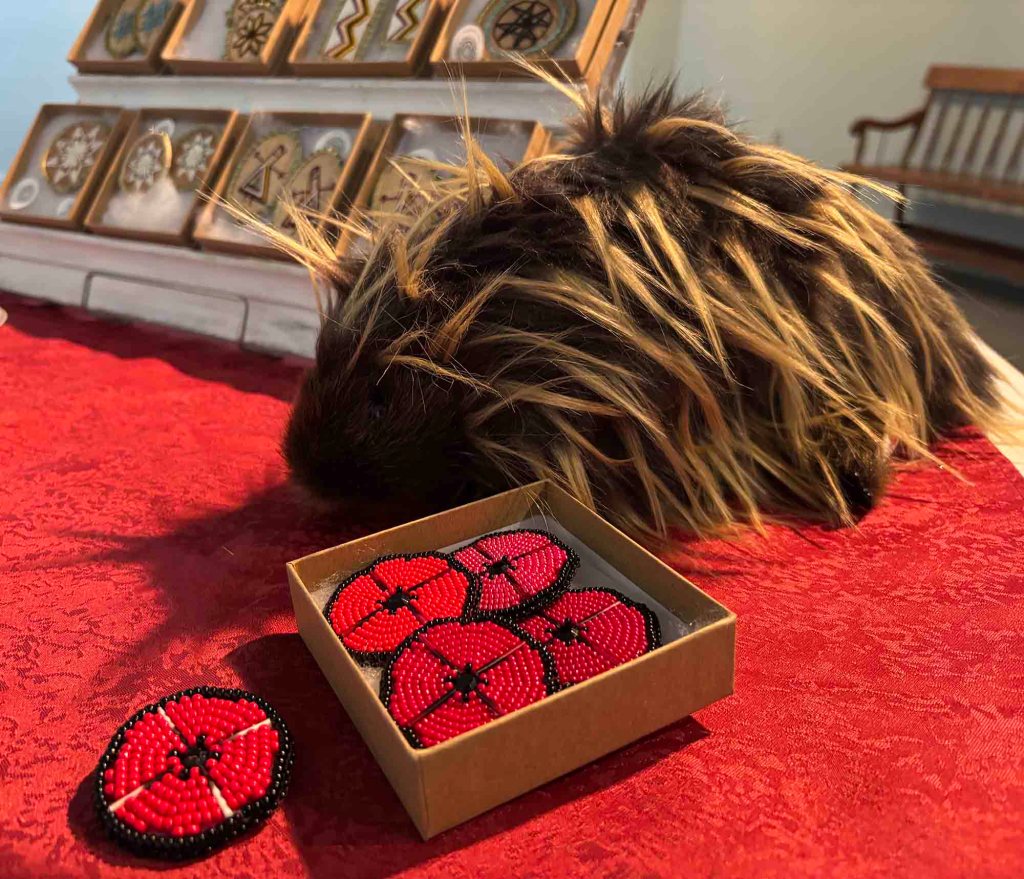
She adds modern amenities to her own workshops: she pre-threads the fine needles used to pick up the tiny coloured beads – “I know what it’s like!” There’s a handful of dollar-store reading glasses in her supplies: “game changers!” She found a hand-puppet porcupine at the Kejimkujik National Park gift shop she uses to describe how she sources her quills. She uses a flipchart to describe how to begin adding the first centre beads. Her poppy kits include a beaded-edged start on the design, with two of the eventual four porcupine quills already added.
“Ouch!” said one participant.
“I broke my quill,” said another.
“Ouch – I found the end with my thumb!” from a third.
“The glasses don’t help – it’s a cognitive issue!” another joked.
Workshop participants started with the red-and-black bead pattern near the centre of their poppies, and then worked in rings of red beads to the outer edges, tacking everything down as they went.
“It’s almost like brickwork,” said Beals, “when you’re thinking of how to put in the next brick and fit it in. If I relax, and let the beads relax with me, the work is so much better.”
“We’ll see what happens…,” a hesitant participant said.
“Oh, I’m working on my perfectionism,” said another.
Veteran spouse Jill MacDonald was one of the first to finish.
“I’m very pleased with myself. I really enjoyed that. I love it – and I’ll wear it!”
Veteran Mitch Curtis, with six years shared between the Canadian Army’s Royal Canadian Regiment and as an aircraft structures technician in the Royal Canadian Air Force, came to the workshop after a cousin made a beaded poppy last year.
“I like the poppy idea. I’m not a crafter –that’s becoming obvious. Just look at it from a distance!”
But, Curtis was downplaying the patience and attention to detail his work now as a tattoo artist brought into his poppy.
Long-time sewer and cross-stitch worker Brenda Mailman offered him reassurance: “well, you know what? Poppies are not perfect.”
Beals said the workshops are an opportunity for anybody to craft their own poppy with meaning: she knows now her birth father was in the military himself.
“It’s kind of fun to see someone wearing one they’ve made, and knowing it was from one of my workshops. Everybody has a connection with the military.”
Find out more about Beals’ Crossroads Beading and Quill Art on Facebook @ Crossroads Beading ( https://www.facebook.com/Crossroads-Beading-100048854536990/ )


Remembrance Day: the wearing of the poppy
May 15, 2025, the National Defence Clothing and Dress Committee approved the wearing of Indigenous-crafted poppies to “recognize and honour the contributions of First Nations, Inuit and Métis peoples” by Canadian Armed Forces members in the same manner as the Royal Canadian Legion poppy, commemorating Canadians who died in battle.
Indigenous-made poppies must be:
- not less than 3.8 cm and no greater than 5.1 cm in diameter
- red with black accents
- the poppy may be made from materials including, but not limited to, beads, seal skin, porcupine quill, caribou bone and other culturally significant materials
CAF members wear the poppy on all uniforms, from the last Friday in October until Remembrance Day, November 11; and are encouraged to wear it when attending any event whose main purpose is to commemorate Canadians who died in battle.
For information on Canadian Armed Forces’ guidance on the wearing of Indigenous-crafted poppies, visit canada.ca/en/department-national-defence/services/military-history/history-heritage/remembrance-ceremony/5.html