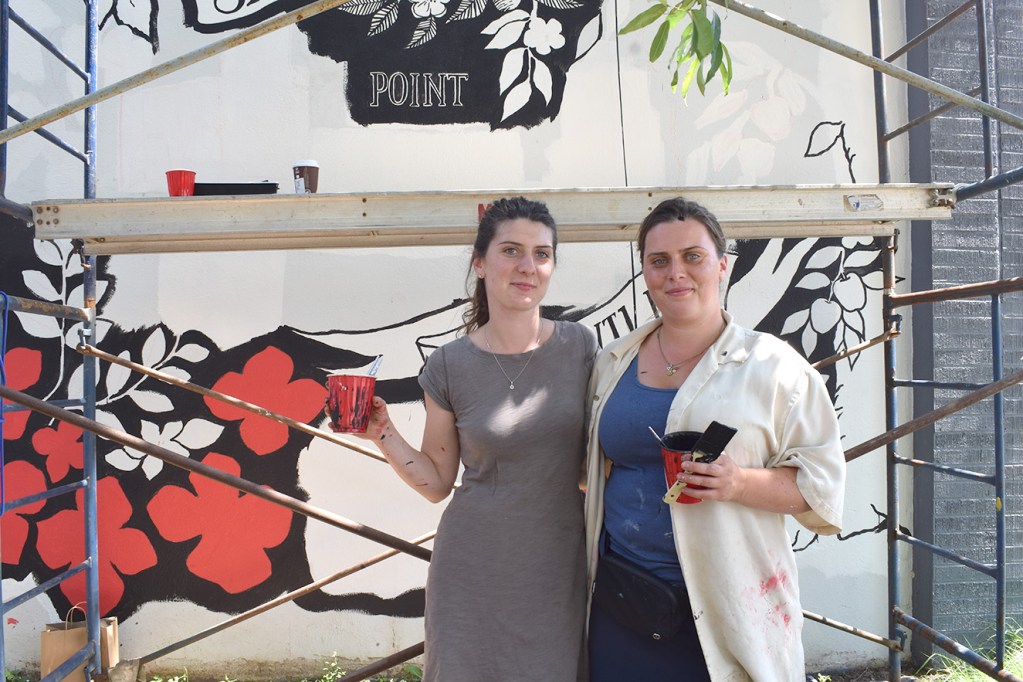
“Education on these historical events is so important because we want to remember the right people,” says local artist Fiona vanWilgenburg, on the inspiration behind her Castel di Sangro mural now on public display in Kentville.
Painted on the wall of Huntley’s Diving and Marine Service on Main Street as part of the town’s annual mural festival, vanWilgenburg’s art reminds everyone of the long-time “twinning” relationship between Kentville and the Italian town of Castel di Sangro. While the most famous battles are still commemorated, many other Second World War engagements – including the West Nova Scotia Regiment’s battle for Point 1009 in Castel di Sangro , during which Valley soldiers gave their lives – are not well known today. VanWilgenburg first learned about Castel di Sangro when she participated in a ceremony held by the WNSR a few years after having joined the regiment as an infantry member.
“This is one of those historical events that, the more you read about, the more you learn – and you just learn how harrowing it truly was. And, of course, it’s a story that nobody knows because it wasn’t a massive, massive win and there weren’t thousands of casualties; it wasn’t big enough to be really remembered.”
Although vanWilgenburg has created several smaller pieces on walls, doors and signs in the past, the Kentville mural is her biggest project yet. The local artist is thankful for the many contributors in her research into the Castel di Sangro story, especially WNSR Regimental Association member Garry Randall, who provided documentation of the events and pictures of the Italian monastery featured on the artwork.
“He has been a godsend in creating this mural. He helped me out a bunch. He lent me a book on the history of Castel di Sangro, and put me in contact with other people who had helpful information.”
The design challenge vanWilgenburg faced was capturing the magnitude of the battle story, while also showing the lasting connection between the towns as a result of the Canadian soldiers’ sacrifices. The WNSR members fought in darkness, rain and gunfire to liberate the Italian town, caught in a deliberate, German scorched-earth policy as one of 10 Upper Sangro Valley villages destroyed during German occupation.
“War is ugly, and there’s so little of it that can be done in a beautiful way. I wanted to do it in a way that would beautify the town, so I tried to pick things from nature or pieces from agriculture that we could put together to create something beautiful and still tell the story,” says vanWilgenburg, “Hopefully, people will see the piece and want to learn more about what actually happened.”
The WNSR’s “B” Company was met with an ambush in Castel di Sangro on its first attempt to capture Point 1009 in the early morning hours of November 23, 1943. With no radio communication, they were met halfway up the cliff by grenades and machine gunfire, and had to jump from the ledge to escape, many breaking limbs on the descent. Sixteen members were captured, 10 wounded and five were killed by the end of the first assault.
Framed by an Annapolis Valley orchard and a Sangro Valley vineyard, vanWilgenburg included a basket of bread and wine in her painting to demonstrate the very human side of war.
“They were completely overpowered by the Germans. They fell down this cliff and had to swim in the river so that they couldn’t be detected. They stayed in the freezing cold water at the end of November, just absolutely brutal stuff; and then, finally, they were about to give up and they happened upon a group of Italians in this little shack. The Italians brought them in and gave them bread and wine and helped them out. I want to tell those sorts of stories.”
She also detailed the names of the fallen WNSR soldiers in the mural’s poppies. It is VanWilgenburg’s hope, through this mural, Lieutenant Joseph Blanchard, Private Arthur Living, Private Harold Titus, Private William Benjamin, Private Peter Schwaga, Private Clarence Cooke and Private Roy Young will always be remembered here in the Valley, as they are by the grateful people of Kentville’s sister town, Castel di Sangro.
The bread and wine basket includes a copy of The Advertiser as a small tribute to Captain Hugh Burns, “B” Company’s commander. Burns survived the war and returned to work for his family’s Kentville Publishing Company. He was one of the original organizers of the Apple Blossom Festival.
While vanWilgenburg has been more recently busy with smaller-scale embroidery work, painting has been a passion of hers since childhood and she would love to take on further projects. Anyone interested in contacting her may message her via her Instagram account, @Fiona_Willowscreative, or email vanwilgenburgfiona@gmail.com.