Greenwood heritage adds interest to timeline of 2024 centennial
14 Wing Greenwood has added it’s share of Royal Canadian Air Force history to a centennial collection marking 100 years of RCAF service in 2024.
The written collection, “100 Objects for 100 Years: A History for the Royal Canadian Air Force Centennial,” made its official debut May 3 at the Wilfrid Laurier University’s Canadian Military History Colloquium.
“We received lots of positive feedback on the book from those in attendance,” says Dr. Mike Bechthold, approached by co-lead author and launch keynote speaker Dr. Richard Mayne almost four years ago to co-lead the project. Bechthold, Mayne and their team worked closely with 11 RCAF-affiliated museums across Canada to select 100 items representing a century of service: no easy task for an organization with a rich history.
“A driving criterion for me was to ensure that a majority of the objects made a personal connection to the RCAF. The vast majority of the objects profiled in the book are connected to specific people or events. For example, we don’t profile a generic aircraft rescue axe, but the actual one used by Andrew Mynarski during the action for which he was awarded the Victoria Cross” says Bechthold.
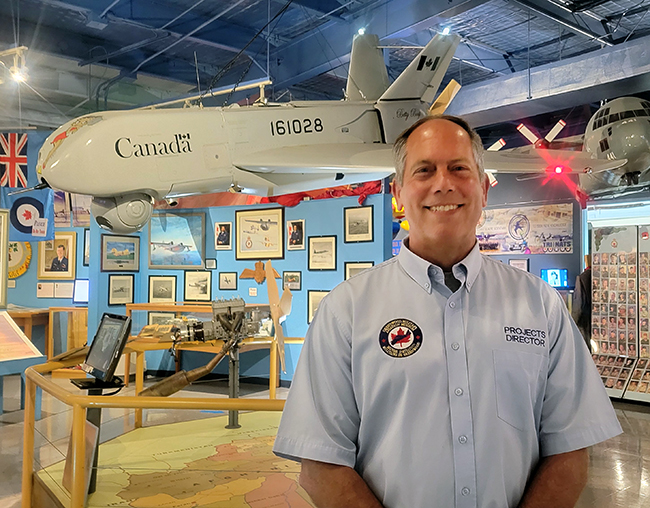
14 Wing Greenwood wing heritage officer Major Brad Wylde worked closely with the team of researchers over the course of the project, helping identify items from the Greenwood Military Aviation Museum collection.
“They definitely picked the right people to do the project. Mike and his team were exceptionally prepared. They took what I provided and went to the next level with it. And it benefited us, because we learned more about the objects than even we knew.”
Much thought was given to the selection of the eight items the GMAM contributed to the book. Wylde’s list was carefully selected to give the most complete representation of Greenwood, its contributions and, more importantly, its people.
One object selected was the Western (Northern) Electric Switchboard, used in Greenwood for over four decades by operators who sometimes worked for three or four days without leaving their post, relying on the base kitchen to provide them with meals as they worked tirelessly to support military operations.
“We wanted to represent the base side support if we could,” says Wylde. Among the people who contributed to mission success here at Greenwood was operator Shirley Moir, employed at 14 Wing for 33 years, and a switchboard worker from 1960 to 1977. “Her story is a Greenwood story.”
The GMAM also provided an item that represents a currently serving member, in Captain Mary Cameron-Kelly’s flight suit. Cameron-Kelly’s career as a pilot in the RCAF is a limitless example of what a passionate and perseverant individual can accomplish. As the first female technical instructor at 404 (Long Range Patrol and Training) Squadron, the first female CP140 Aurora pilot and the world’s first female maritime patrol crew commander, Cameron-Kelly is a modern-day role model for girls who dream of pursuing a career in aviation.
“Of course, her story keeps going,” says Wylde. “She was nominated for the aviation hall of fame this year.”
The museum takes pride in inspiring younger generations who visit the displays, but also makes sure their experience learning about the RCAF and Greenwood’s history is a memorable one. One of the stories Wylde delights in sharing with younger audiences is that of 449 (Maritime Training) Squadron’s unicorn horn.
“It’s a riot when I give a tour to the kids, and they say unicorns don’t exist, and I tell them, ‘no, no, we have a unicorn out back.’”
Wylde then takes his group to visit the resident (plush) unicorn, which always gets a laugh out of the young visitors. It adds a unique touch – and one they will surely remember – to a story that’s part of Greenwood’s heritage. Wylde was happy to see the horn take its place in Bechthold’s collection.
“It’s a story about a squadron that started and ended here in Nova Scotia, and I felt it was nice to represent a squadron that was short-lived and local and doesn’t have a lot of representation in museums.”
Wylde is eagerly awaiting the arrival of the first hard copies of “100 Objects for 100 Years” at the museum.
“We said we want as many copies as we can get.”
While the book may be used in the future in the presentation of awards and gifts, Wylde would love to have enough copies available for visitors who wish to learn more about the RCAF’s heritage and Greenwood’s part in it.
“My role is to tell the story of the history of Greenwood, so if I can have a book here to help point visitors to specific objects, that would be great.”