Charles Tidd was promoted to sergeant the night before the West Nova Scotia Regiment was on parade in Annapolis Royal, where members would receive their new regimental colours from then-Lieutenant Governor Major-General the Honourable E.C. Plow. He was up late sewing on his rank badges: as the right marker, and with his height, he’d be noticeable.
That was 1959. The regiment’s Queen’s Colours featured the Union Jack in the background, and the regimental Colours included 16 of its 36 Battle Honours, dating back to the War of 1812. While Tidd isn’t that old, sitting as a spectator during the September 24 presentation of modern-day Kings Colours and updated regimental Colours, “I enjoyed it all.”
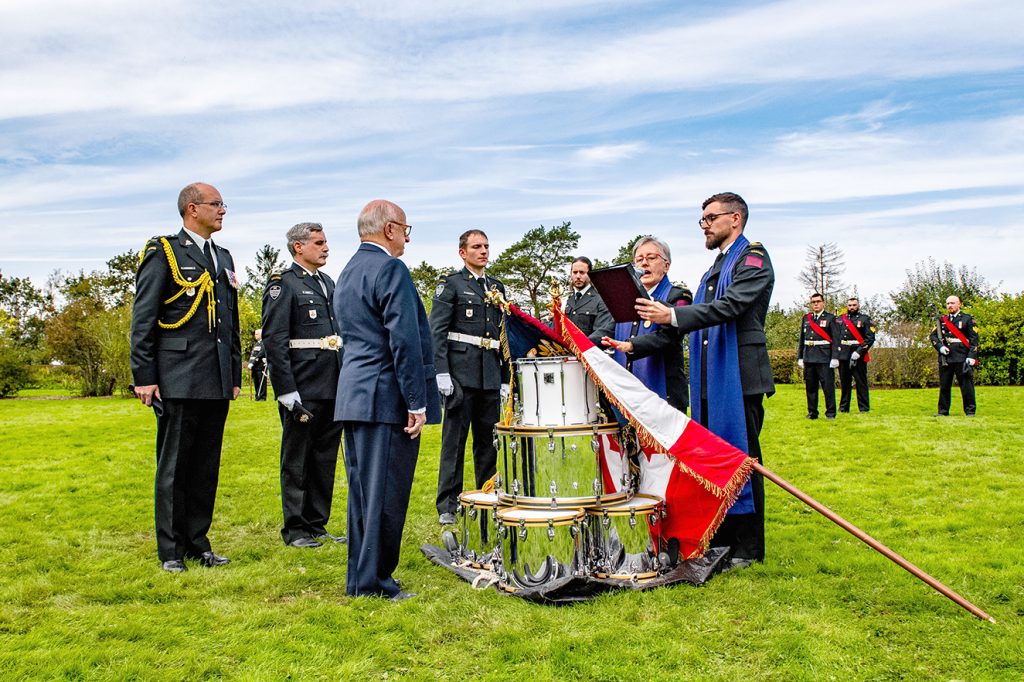
The WNSR hosted a parade on the grounds of the Church of Evangeline, in the Grand-Pré National Heritage Site, where it received and consecrated new Colours, presented on behalf of King Charles III by reviewing officer The Honourable Arthur J. LeBlanc, ONS, QC, Lieutenant Governor of Nova Scotia. Military dignitaries from 36 Canadian Brigade Group and 5th Canadian Division, former WNSR members, Cadets and community guests – plus Grande Pré park visitors who happened by – were treated to colour, tradition, music and the ceremonial consecration of the Colours, draped over a drum stack set on the lawn of the parade square.
The new King’s Colours are emblazoned on the Canadian flag, and the regimental Colours represent two new battle honours, including one recognizing the regiment’s service in Afghanistan.
Town Crier Lloyd Smith reminded everyone in his opening of the Grand Pré grounds as significant, representing one of the regiment’s cap badge elements.
“This land has gone by many names – but one thing has always been constant: the requirement for strong and capable soldiers to maintain its defence,” Smith called, harking back to the 18th and 19th century efforts by local militias – Valley and South Shore regiments that were the forefathers of the WNSR from as early as 1717.
“Since 1945, soldiers have been across the globe in a variety of duties, forging the next chapter of the regiment.”
Captain Evan Colford, the WNSR chaplain, described the consecration of colours as a time-honoured tradition, “representing the service and sacrifice of the regiment in its duty to the sovereign.
“It is an emblem that signifies the laws and duties they are asked to uphold in the pursuit of justice and peace, with honour and dignity,” he said. As the two Colours were draped over the stacked drums in front of LeBlanc, Colford invited “those called to serve under these Colours to respond, ‘I renew my loyalty.’”
The WNSR members on the parade square responded firmly, as 36 CBG chaplain Major Andrea Harrison further invited them to consecrate the Colours “in memory and in remembrance of our fallen comrades in arms.”
LeBlanc, speaking as King Charles III’s representative, reminded all Nova Scotia saw the first sovereign’s Colours presented on Canadian soil May 31, 1777, and this WNSR presentation marks only the fourth presentation of Kings Charles III’s Colours in Canada. LeBlanc himself presented the last Colours of the late Queen Elizabeth II in the fall of 2021.
“Colours have always represented the history and sacrifice of a regiment, and are truly its heart and soul embodied. Even I, as a civilian, find these symbols of sacrifice, honour and heritage deeply moving. Thank you.”
36 CBG Commanding Officer Colonel Tim White welcomed serving and past WNSR members, commending them all for “unwavering dedication that reaches deep into the hearts of your communities. May these new Colours inspire us to live up to the values we hold dear. May we forever be united by these Colours that bind us.”
The parade was the highlight of a weekend of WNSR events, including its regimental association annual reunion and a joint regimental dinner, group photos and a time for social gatherings.