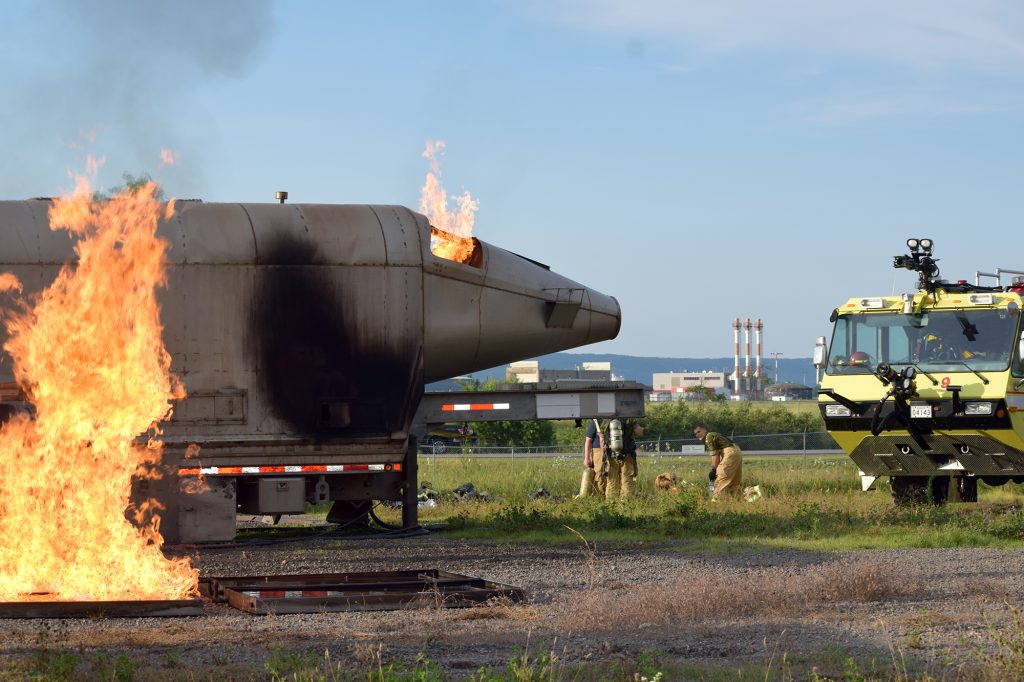
The Canadian Armed Forces (CAF) mobile aircraft fire trainer (MAFT) spent time this summer with 14 Mission Support Squadron’s Fire and Emergency Services team, enabling annual re-qualification training.
The MAFT is a CAF-wide asset that travels from wing to wing, giving firefighters the opportunity to train in aircraft rescue and firefighting (ARFF) using realistic scenarios. The trainer simulates different aircraft fires using propane as a fuel source (which burns cleaner than class A fires), and a smoke generator. Scenarios include fuel spills, engine fires and even rescues, where firefighters drag metal manikins out from various locations in an aircraft.
14 FES’ assistant deputy fire chief, Warrant Officer Philip Drost, says this hands-on training is vital to the team, whose foremost responsibility is airfield response.
“This is our primary job. We practice so it’s not difficult when we respond to an emergency.”
The biggest challenge for new firefighters is getting used to operating the ARFF vehicles while communicating over the radio and fighting the fire itself. Being able to train with the intense heat, low visibility and confined spaces the simulator provides ensures, in an emergency, the team will be prepared to perform quickly and effectively.
“It’s getting used to doing three or four things at once.”
The MAFT also provides 14 FES members the opportunity to strengthen relations with other fire departments in the community: both Shearwater military firefighters and the Kingston District Fire Department’s volunteers were able to join 14 FES in MAFT training at Greenwood. Getting to work closely with the local department is essential in fostering familiarity and strong working relationships. 14 FES has a mutual aid agreement with the Kingston Department, which would assist in ARFF response outside the wing. Master Warrant Officer Ed Fairhurst, 14 Wing’s deputy fire chief, is happy to see the departments training together.
“Kingston is our number one backup should anything happen. Our main priority is the airfield, so Kingston’s been an asset for us to have for structure firefighting – and any kind of backup at all, really. To understand each other’s capability and how each other works, it’s really important to have this joint training. We just started it this year, and this is our probably fourth night together. Things are going great, so I hope to continue this, for sure. It’s a real asset to the members of 14 Wing and the community as a whole.”
Kingston District Fire Department’s Deputy Chief Troy Bruce agrees the training is vital for both departments to be able to fully support their community.
“It’s something new to work with an aircraft prop, but being neighboring to Greenwood it’s very beneficial to work with something like this in the off chance that something was to go wrong with anything on the base,” says Bruce. “It’s instrumental to be able to see what they do, how they would respond and then the expectations for us when we are called in. Practicing and combining our departments and working together in the event of a terrible catastrophe is absolutely beneficial.”