Petty Officer Second Class Michael Quesnelle was intent on highlighting the team, support and family feel of a potential career in the military for participants in the latest offering of the Canadian Armed Forces Indigenous Entry Program.
Visiting military workspaces and meeting personnel by day over the three-week program, Quesnelle considered evening activities in Nova Scotia that may be familiar to CAFIEP participants: fishing for striped bass on the Shubenacadie River, canoeing, a campfire and downtime that encouraged conversations.
“We build the CAFIEP as a ‘small family,’ and, really, the military can be like that,” Quesnelle said May 12, as the group spent the afternoon at 14 Wing Greenwood before heading to an overnight in mod tents with MREs at 5th Canadian Division Support Base Detachment Aldershot.
Quesnelle typically works as staff for the Naval Fleet School (Atlantic) Primary Leadership Qualification course. When he heard the CAF was re-starting the CAFIEP for the first offering in four years (blame COVID-19), “my hand went up.
“I have Metis and Ojibwe background, but it was never much for me – my father joined the military in the 1908s, and he always said it was better to just downplay culture and any differences,” Quesnelle said. “I have been learning so much.”
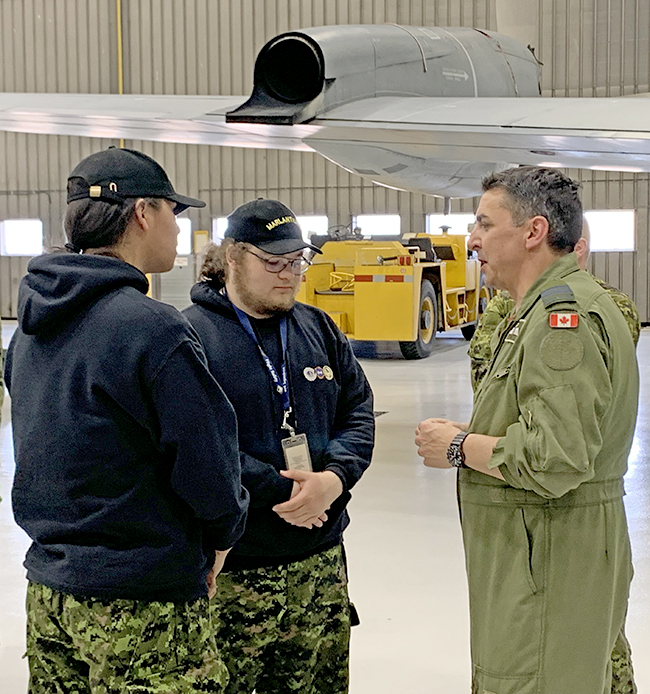
At 14 Wing, the CAFIEP group, about a dozen, including participants and staff; were welcomed at 404 (Long Range Patrol and Training) Squadron by 404 Squadron Deputy Commanding Officer Keith Tagg and 14 Operations Support Squadron Corporal Nicholas Whaley, the military co-chair of the wing’s Defence Indigenous Advisory Group.
“We are in the traditional territory of the Mi’kma’ki,” Whaley said, “and the DIAG is pretty involved here at 14 Wing – we bridge the gap between the defence community and our local First Nations communities in Bear River, Glooscap and Annapolis Valley.”
The DIAG may offer guidance to military peers planning an exercise in the wider community, suggesting ways to consider or include First Nations communities or individuals in search-and-rescue trainings, or the use of land. The DIAG organizes wing events recognizing significant Indigenous dates, including flag-raising, awareness campaigns and guest speakers. May 11, the DIAG held its first Moose Hide Campaign, with members invited to wear a piece of moose hide wear they would wear the traditional poppy, but this in awareness of the Indigenous effort to engage men and boys to help end violence against women and girls.
“And you would have driven right by our teepee at the main gate – there was no wind this morning, so it went up really well!” Whaley said. “Next week is Indigenous Awareness Week here.”
Day-to-day, military work offers personnel challenging opportunities. Captain Rob Albert, 404 Squadron’s Standards Training Flight training enhancement officer, described to CAFIEP participants how 404 Squadron provides new and on-going training to air crews and technicians from across the Canadian Armed Forces, ensuring they are “Ready to Fight.
“More and more units are finding out what we can do,” Alberts said, from teaching technical skills to peer CAF embers to augmenting or making up their own operational crew to fly the Aurora. “We run over max capacity – we’re running courses all the time, we supplement operational squadrons to maintain our proficiencies and we go do our own missions.”
Tom Gorman, a retired CAF member now working within the squadron’s simulator training program, lead a tour through spaces with actual aircraft equipment and technology, and with state-of-the-art cockpit simulators.
“Everything is identical to the aircraft, and the trainers are augmented so we can introduce faults to test students. The trainers are very immersive, teaching real-life skills beyond a book or a PowerPoint. These are low-risk environments to train technicians and crew to then go out and work and fly with confidence.”
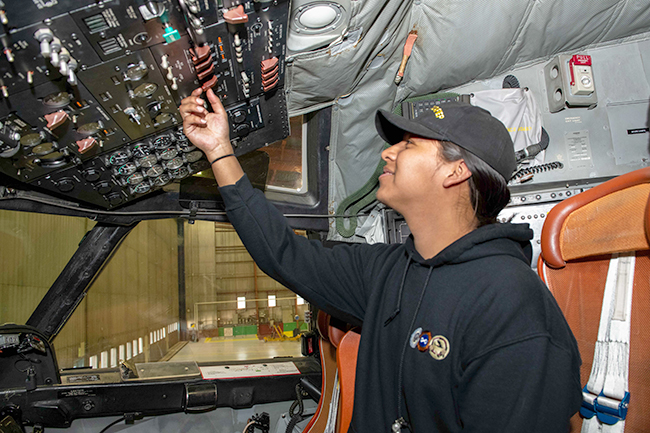
Across the parking lot at 11 Hangar, several technicians were on hand to tour CAFIEP participants through one of 405 (Long Range Patrol) Squadron’s CP140 Aurora aircraft, and describe their own roles in making missions happen.
Quesnelle watched his group interacting with 14 Wing Greenwood visit guides – just the environment the CAFIEP should be offering participants through navy, army and air force environments.
“We have a recruiter embedded with this group, and they can watch for any of the ‘sparks’ and feed participants the information they want and need to consider the military for themselves.
“When they are done, they’ll have done a FORCE test, a first aid course, the aptitude test; seen a bunch of opportunities – maybe they’ll be interested in joining.”