Captain Rob Albert,
404 (Long Range Patrol and Training) Squadron
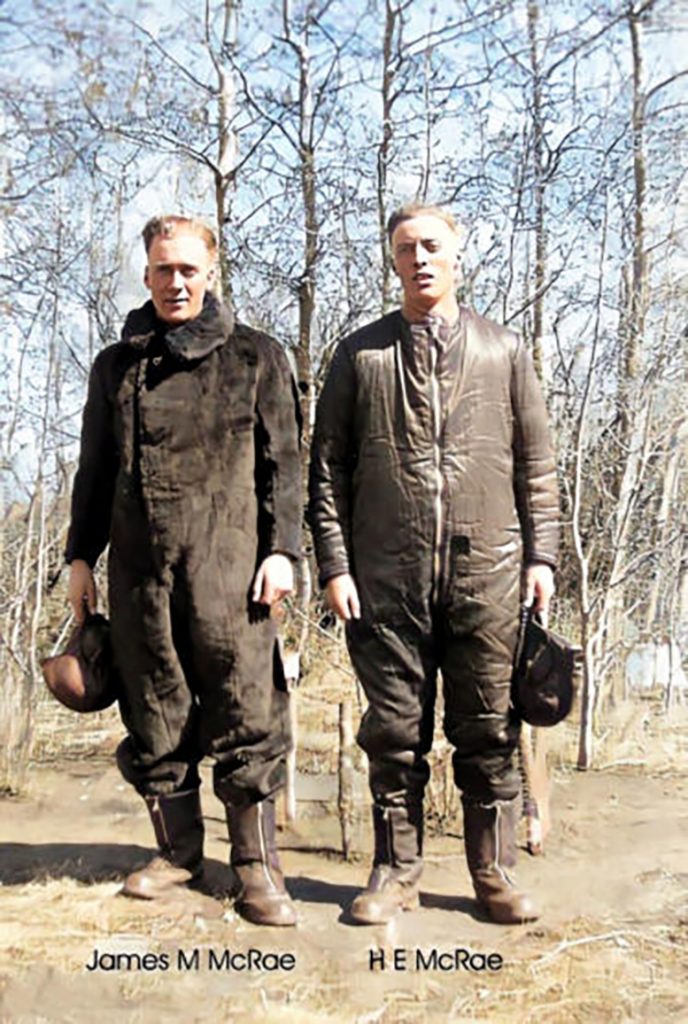
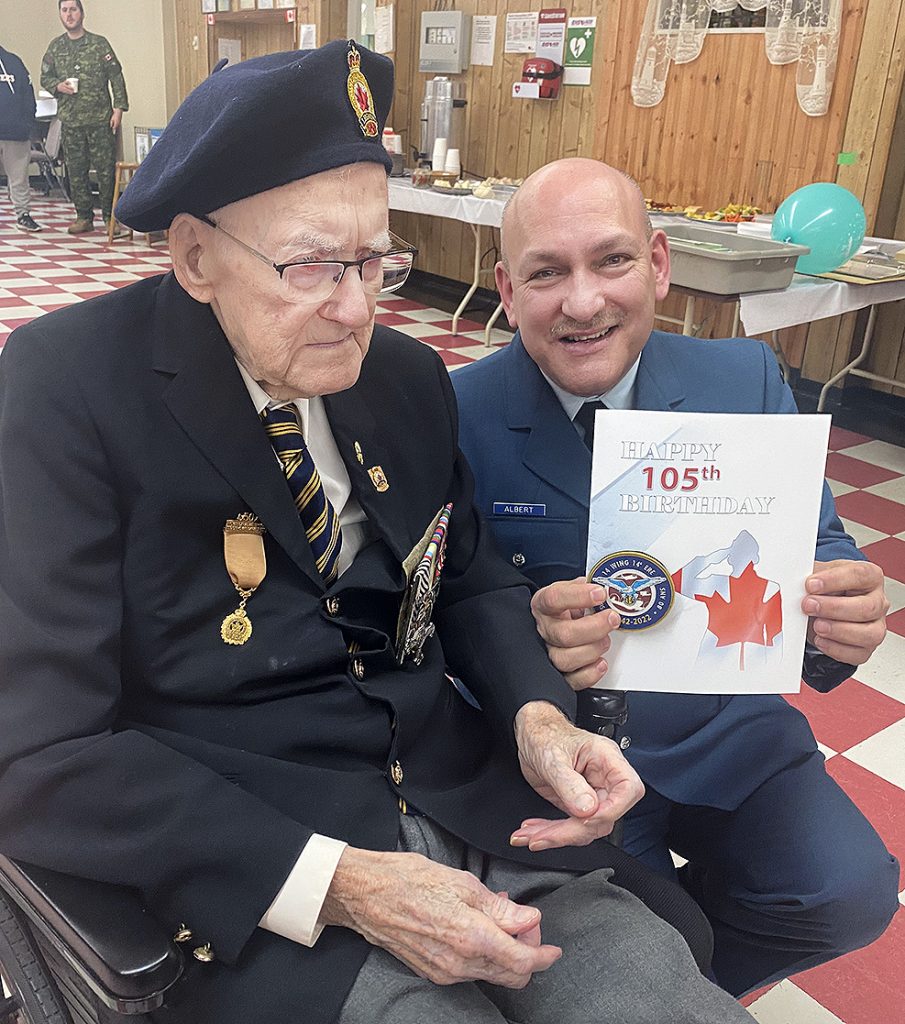
Flight-Lieutenant (retired) James M. McRae DFC CD celebrated his milestone 105th birthday in the presence of friends and five generations of his family, including his five-year-old great-great-granddaughter, and the wider community.
November 28, the Royal Canadian Legion Branch 61 Yarmouth, hosted a birthday celebration McRae, with local and provincial media on hand.
Even more cards were delivered toward a 105-card goal, set at the most recent Remembrance Day service by officiant, Rev. Bill Newell, as he challenged people to send McRae a card – hoping for 105 cards by his birthday. With the help of social media, the final total was just shy of 900 cards and well wishes. These included several local elementary schools, who sent packages, and a number from 14 Wing Greenwood members, including a special card signed by 14 Wing Commander Colonel Jeff Davis and Wing Chief Warrant Officer Jonathan Proulx.
After a round of “Happy Birthday,” McRae cut a large, curling-themed cake and received certificates from several presenters, including Yarmouth MLA Zach Churchill, Mayor Pam Mood, the Yarmouth Fire Department, Canada Customs and the Royal Canadian Legion; recognizing his long life and many accomplishments.
14 Wing was planning a 500-foot fly-past honouring McRae; unfortunately, Mother Nature did not cooperate, providing a 500-foot broken layer of cloud precluding the maneuver. Having flown Second World War Canso aircraft in search of U-boats over the North Sea, McRae is quite familiar with weather issues and their effect on flying. He was disappointed, but he understood. He did get to see some of the aircraft present in the area for “Dumping Day” (the first day of the lobster season) the next day and quite enjoyed the show, even if it wasn’t specifically for him.
It is rare to see a DFC, let alone on someone’s chest. McRae may be the last living recipient, with the passing of his navigator during a fateful 1943 mission, Flight-Lieutenant David Waterbury, at 100 years of age this spring; and Lieutenant-Colonel Russell Hubley, a gunner with 405 Pathfinder Squadron, who passed away on Remembrance Day, just shy of 101. Both were residents of Nova Scotia and both also wore the Distinguished Flying Cross.
In the years following the war, McRae rejoined the military and worked as an air traffic controller. With a nod to his love of flying, he co-founded and operated a flying school in Yarmouth. He also served as one of the town’s paid firefighters, drove a bus and eventually settled into a job with Canada Customs, retiring in the early 1980s.
404 Squadron and Captain Albert have maintained ties with McRae and his family, visiting annually since he and his significant DFC were recognized at the 2019 Remembrance Day ceremony in Yarmouth.
McRae’s children say he didn’t talk much about his wartime experience. His granddaughter did not know what the DFC was until a pilot friend asked about it. McRae is a proud man, but very modest. He has seldom spoken about his wartime experience and, during our first 404 Squadron visit in January 2020, his family heard many details they didn’t know about his service while he was talking with fellow military aviators: it may sometimes be easier to speak with those who have a common reference. He downplays his accomplishments (and they are many!), but his memory of events is very clear, and he has told the DFC-rewarded story in recent years, perhaps since it is now available online, as he wants to keep the record straight.

Flight-Lieutenant (retired) James M. McRae DFC CD was awarded the Distinguished Flying Cross (DFC) for his participation in the sinking of a German U-boat in the North Sea during operations in support of the Normandy Invasion. The conditions for awarding of the medal read as follows:
“The cross is awarded to officers and warrant officers for an act or acts of valour, courage or devotion to duty performed whilst flying in active operations against the enemy.”
After encountering the U-boat on the surface in the North Sea June 13, 1943, the crew successfully deployed depth charges, sinking the vessel. Upon returning for confirmation of the sinking, the U-boat gunner was able to shoot at the oncoming aircraft, taking out an engine and penetrating the hull so it couldn’t float once it landed in the water. Taking on water, the crew deployed the life rafts, only to find the CO2 bottles had been over-filled: the one raft exploded, sending their survival gear to the bottom. With only one five-man life-raft for eight crew, they climbed in – to find the raft leaking from a puncture. They spent the next eight hours taking turns to cover the hole. (This may be the origin of the relief valve and hand pump we have in our life-rafts today.)
Eventually, a second raft was air-dropped to them by a Norwegian crew aboard a Royal Air Force aircraft, and they were eventually rescued by an air force high-speed launch.
Unfortunately, three of crew succumbed to exposure before the rescue. Several members of the crew were awarded medals: a Distinguished Service Order, three Distinguished Flying Crosses and a Distinguished Flying Medal; for their actions that day.